Click here for a link to a presentation I did about analytics. Preview Below.

Looking at strategy & markets through data science and machine intelligence.
Click here for a link to a presentation I did about analytics. Preview Below.
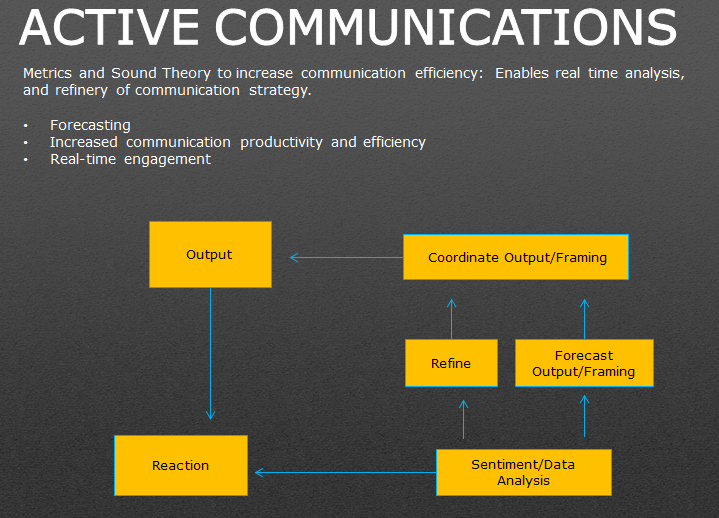
The idea of “Active Communications” is based heavily on media monitoring listening data AND proper framing, which is a bit of an art (unless you have first class AI/NPL skills) . To work efficiently, a multi-channel infrastructure that allows for real-time content is paramount.
Important concepts to take away:
Perhaps the biggest aspect is willingness to abandon prior methods after the data is received. You might be more comfortable with Twitter or another channel, but for the specific campaign it could be a waste of time. Don’t fight up stream.
WHY IS ONLINE MEDIA IMPORTANT TO LOOK AT?
I examine this question with the help of Charts and the EU. Thank you..Click on the Charts to make them bigger.

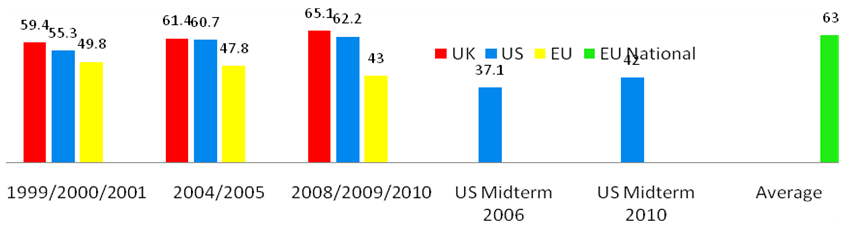
So why is looking at on-line media important? The chart above (Lau, 2001) shows online media has expanded in the last 16 years. Online news has displaced print and broadcast to represent 46 percent of all content monitored globally. Increasingly online communications/media is becoming the main source of people’s knowledge for political affairs. In the era of the mediatization in politics and democratic theory, which assumes that an informed and attentive public is necessary for democracy to work effectively (Lau, 2001), understanding on-line communications is vital.
The Analysis of on-line media is a cross between what’s called data science[1] and “Culturomics” (Leetaru, September 2011). The goal is to find cultural trends through computerized analysis of online media to develop insights in the functioning of human society, thoughts and actions (Michel, et al., 2011). This process has been very accurate in forecasting instances such as box office sales (Mishne and Glance, 2006) to the stock market (Bollen, et al., 2011). To illustrate the power of data science and sentiment analysis in a political context scientist – using a super computer, applied tone and geographic analysis to a 30 year worldwide news archive. The scientist were able to forecast the revolutions in Tunisia, Egypt, and Libya, the removal of Egyptian President Mubarak, the stability of Saudi Arabia, and estimated Osama Bin Laden’s hiding place within a 200–kilometer radius, in Northern Pakistan.
The point of all of this?
Media is a very accurate source for insights into the human condition, as well as our thought process. Now with the rapid expansion of online media, there is a wealth of untapped knowledge and syntax to further analyse.

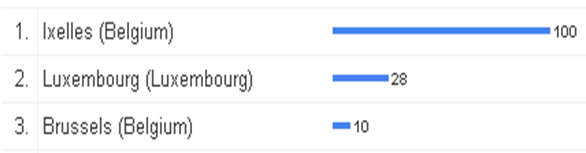
[1] With Google Insights for Search, you can compare search volume patterns across specific regions, categories, time frames and properties. See examples of how you can use Google Insights for Search.
[2] Google’s search market share in Europe is around 90%. In the U.S. it’s around 65%.
[1] The profession of interpreting and creating value from Data.
I thought that I would post a trend chart that I found. It is from the 2011 summer of rebellion. Please ask questions:

“The race is for a system digital currency wield the most social influence. One particular player has emerged, Klout, determined to establish their platform as the authority of digital influence. Klout’s attempt to convert digital influence into business value underscores a much bigger movement which we’ll continue to see play out in the next year. To some degree everyone now has some digital influence (not just celebrities, academics, policy makers or those who sway public opinion). But for the next year, the cult of influence becomes less about consumer plays like Klout and more about the tools and techniques professionals use to “score” digital influence and actually harness, scale and measure the results of it.”
– Just use Klout for Accountability. If the communications Unit’s goal is to get online, Klout can be a good way to hold people accountable. Nothing more at this point but there seems to be potential.
Well yes and no. [Good] PR has always been about understanding human perception/biases not “emotional IQ” or “social media savvy” [bad PR]. The medium in this case – “Social” Media, is just another way to leverage and understand innate human traits/bias. Although there is some evidence that illustrate some biases are dynamic/changeable, largely people are not interacting much different now from the digital realm than real life. i.e. human behavior and cultural patterns/perceptions and need for expression creates the digital or social media instance – not the other way around. In other words Bernays would be just as effective now as he was then. The medium to the method is mostly arbitrary to said human behavior/bias needed to be leveraged.
 Machine Lens