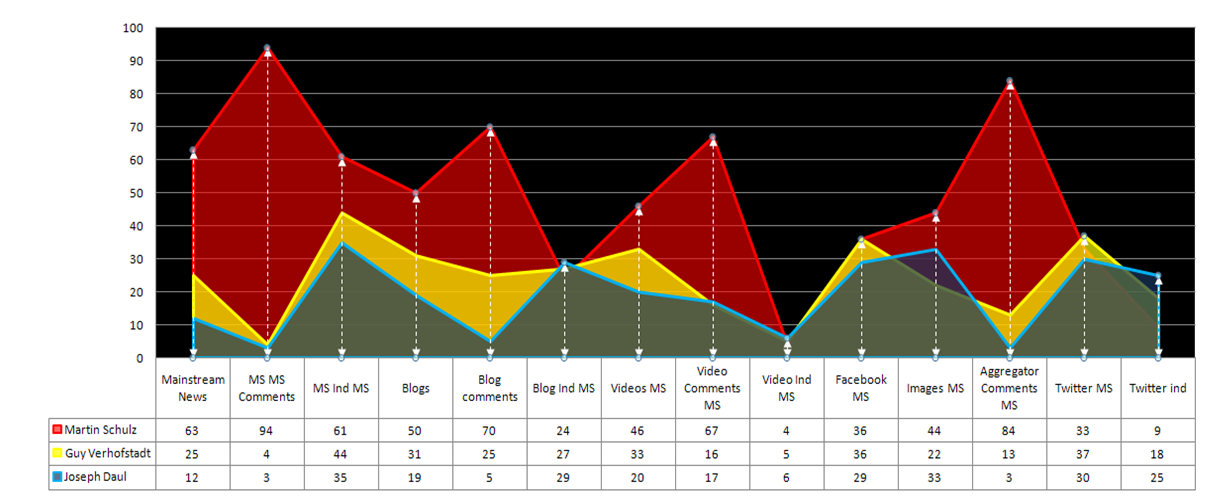
European Parliament Leadership: Channel Marketshare


While it’s trendy for public affairs professionals talk about social media, Twitter and Blogs, it’s naïve to think these are the main channels for engagement when it come to European Parliament Party leadership. Online mainstream news simply dominates in comparison.  It sets the tone of the issue, gets the most comments, and is shared ,“Liked” and Voted on the most.

Diving back into market shares and what leader controls each medium. The chart above shows  just how dominate Martin Schulz (at the time leader of the S&D at the European Parliament. Schulz has now replaced Jerzey Buzek as it’s President) was in December. MS controlled just about every medium, as well as has the most comments.

Starting from the right we see Mainstream News percentages and how each leader stacks up:

  • Martin Schulz (MS)  63%,
  • Guy Verhofstadt (GV) 25%
  • Joseph Daul (JD) 12%

On the second box from the left “MS ind MS” shows the market share of the medium/channel, in this case mainstream, is being use by the Party Leader. Mainstream news made up 61% of Martin Schulz’s online media. Comparatively GV is at 44% and JD is 35%. In all cases main stream on-line news provides the most media and comments for all leaders. Over the past six months I’ve seen a rise in Twitter, which is by far the most equal platform, and also JD’s 2nd highest individual medium.

We can conclude two things from the prior chart:

  • MS is winning the online battle for media and engagement. He owns 94% of comments leaving only 4% to GV, and 3% to JD.
  • JD severely under performs given the EPP’s size and amount of money they have.

Communications as Productivity

By looking at Communications in terms of production and variables, you will save millions. By not understanding variables in communications, you will loose millions and time. Gone where communication firms can pass  Bullshit. Now it’s far from an art form with metrics. Clients should expect decision making based on sound research, in addition to  web analytics and online monitoring data.

The goal: Create the most productive syntax, which could be words, photos,video or interactive digital content. Not the most view and clicks

Resonance: 

Output time/date to channel dissemination, and how much time  that takes. It shows language adoption, which is how you win. There’s a saying politics, “Win the language battle, win the war”.  Resonance is a good KPI for knowing if the framing has retention, thus productivity.

Its can also be useful to reverse engineer a past event’s content and framing with machine learning to compare and contrast. Again don’t focus too much on “click and looks”. You might see exponential gain which perhaps are linked to offline events. That way you can also map correlation. I tend to see this pattern a lot working in politics. This reiterates the massive amount of information available on-line by listening.

More Tricks:

Use best practices in cognitive ICT, psychology,linguistics and behavior economics. A real expert will know captology, sentiment analysis and gamification, and not neglect fundamental and technical analysis.

When you understand the basic variables, you see that  each enhances or destroys productivity.

If the person you hired  doesn’t understand what I’m talking about, the strategy will loose productivity. Ask yourself, why we are paying 200-300 plus per hour? Educated guessing is over. The data doesn’t lie.

European Parliament Leadership sentiment: Guy Verhofstadt Wins

The chart illustrates that overall sentiment of Group Leadership in the EP.

Joseph Daul who is president of the EPP Group (largest EP Party) is lower than Guy Verhofstadt (ALDE) and Martin Schulz (S&D). During the state of the Union address (first spike) Schulz  beat out Verhofstadt. This had to do with the S&D being perceived as competitor to Jose Barroso so the general media sought out his for his views on the event/speech.
Blue = Joseph Daul
Yellow = Guy Verhofstadt
Red = Martin Schulz
Online Web Sentiment of European Parliament Leadership