Barroso and Kerry Analysis

I decided to break down the events of John Kerry visit to Jose Barroso. The reactions are not drastic as I would have thought considering GMO’s and IP are two issues that people care about on both continents, and the Free Trade Agreement is making some actual headway. We will have more on this in the future, but here are small bits of data for starters

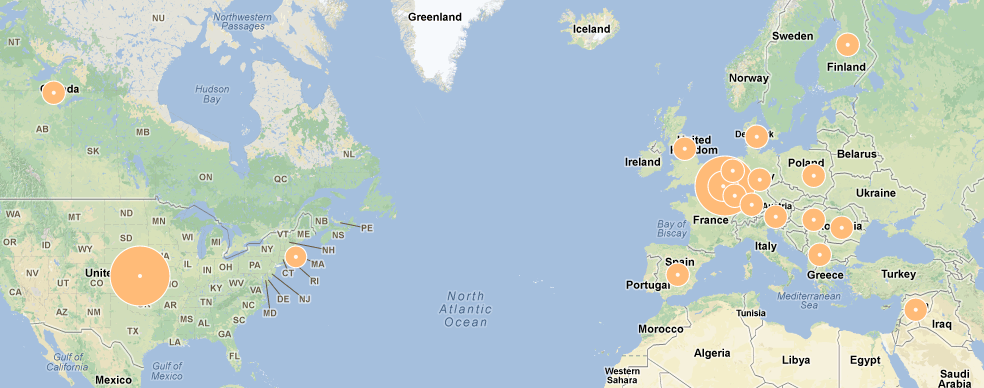
map barroso&kerry
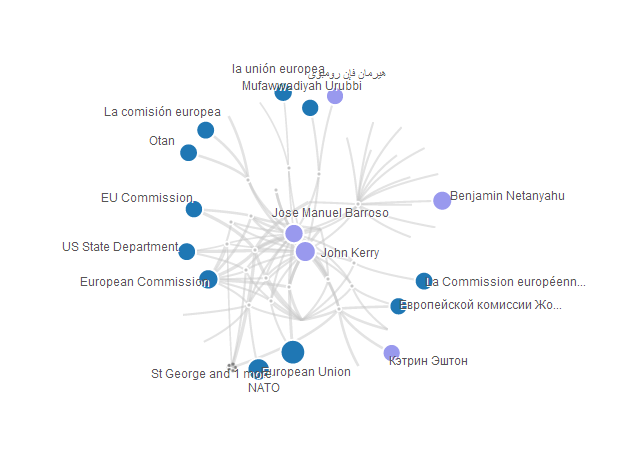
We see that the reporting on the John Kerry and Baroso event is reported on in Brussels 33 times – much more than any other area except for the entire US. Below we see events with organizations and people that both of them together are tied to.
Social Network Barroso & Kerry

Cross referencing what each leader said within the context above is where it gets interesting. Questions to ask: Who were their targets? Did they attain any impact?

Twitter overlap Kerry Barroso

When I first arrived to Brussels I was always amazed at how disconnected D.C was from Brussels with that I decided to look at who was following who. We see that only 1.1% follow both. In short they are disconnected networks. For Comparison sake I also did Obama V Barroso but since Obama has over 30 million follower, the tools I was using at the moment couldn’t process such large amounts of data.

The EU: Hooking up with Technology

Jose is trying to learn how to get a date . There’s a conference at a local hotel on how to pick up women. On his way to the room, Jose’ encounters two doors. One  leads to the conference taught by men on how to pick up girls. The other door has a  sign that says “Successful single women’s conference. Please join us for a drink,  anyone is welcome”.  Jose chooses the first door as he had planned, and continues learning about how to pick up women. The EU relationship with using technology is  like Jose’s approach to trying to pick up women, hesitation and unwillingness to  adapt in real-time, to the peril of the end goal – i.e. institutional.

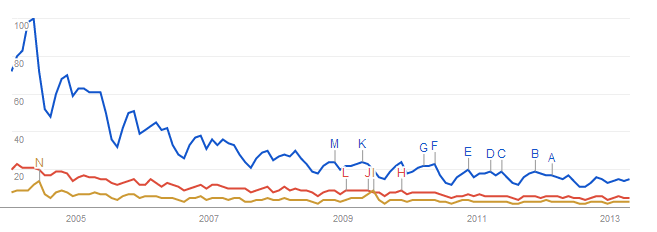
One day I was talking about online media monitoring to the  institutions “social media expert”.  I was asked  “why do we need to understand what people are saying about us?” I was shocked and had no answer except to point out Interest in the EU has gone down every year since 2004 http://ow.ly/8w2Gs. Specifically alarming was that the Parliament, which is supposed to be the extension of the people, had the lowest interest rate.

googletrends
Blue – European Union
Red – European Commission
Yellow – European Parliament

Now having worked in US politics,  a good place to start making a more legitimate government, is being more representative of constituents..and understanding what people are saying about you allows you to create better policies and messages that can help engage people, and perhaps increase the voting rates.

Both EU firms and institutions spend way too much time discussing what technology such as social media is, or what it means, but never act. For example Friends of Europe just released a paper about social media . Frankly I found it pointless, uninteresting, and six years too late.

In the globalized future hesitation is dead, improvisation is king, and competition will be fierce…

Thinking about the “social media experts” statement further, I concluded it wasn’t that  online monitoring wasn’t useful for their situation, but it’s use would have created a real-time approach. This is  the antithesis of institutional process Europe is way too familiar and comfortable with.  And incentive for the people working in the institutions wasn’t there either.

In the USA, competition has led to campaigns and politics becoming a  science. And voting rates + political involvement have gone up. 

The 2012 campaigns featured natural language processing, text mining, sentiment analysis, and data scientists. These technologies will marginalize every medium and word. There was  no room for “educated guessing”. This is efficient, saves time and  money, plus leaves the politicians to focus on empathizing more with the electorate. Forward to the EU. The system is not competitive. The money is provided by the public, and the European Commission is in charge of mobilizing people in a non-political way, which is inherently very, very difficult.

The future will embrace non-understanding, chaos and real-time data, you don’t get the luxury of writing a 10,000 word strategy paper. At present the EU mindset is not equipped to handle this transition. It  must remember if it wants to  hang out with future technology, it has to first quit talking, and ask it out on a date.

Ciao, CT

A Quick look at 20,000 Tweets about the EU

From October 25 -> December 4th there were 20,022 Tweets Containing the words European Union, European Parliament and European Commission. This means tweets were quite specific and could not be mistaken for anything else, further of course the majority of posts were in English, although more than 30 languages were represented. Many of the quick findings reinforce numerous Social Network Analysis studies which show that most network opinions and frames are controlled by a minority of people – between 10-20% i.e.  elite level. Social media, despite a lot of hype, has not changed this.

Image

The context surrounding these 20K Tweets

  • Were produced by 13,832 accounts
  • Retweets made up 28% of all Tweets
  • The Top 18 Tweets – in terms of most retweeted, made up 9% of all tweets
  • Top 18 Tweets that made up 9% of all tweets were made by 11 accounts
  • The most visible and retweeted Tweet was a coalition with FC Barcelona (below) – ( This leaves me to question why are there not more collaborations between the public and private sector in the EU?)

Image

Top Accounts from Top 18 Tweets:

  • Wikileaks – 6 Tweets in Top 18 (33%)
  • Economist – 2 tweets in top 18 (11%)

Top Users commenting on the Euro. UKIP is seems to be taking a proactive approach to framing it’s primary fodder against the EU (the Euro Crisis).

  • @UKIP 32
  • @YanniKouts 23
  • @lindayueh 18
  • @AssangeC 9
  • @LSEpublicevents 8

Analytics and the Global Political Environment

In the global political environment a holistic view is needed.

The standard for message delivery is high in the modern media environments. It’s vital to create communications that people identify and empathize with. The threshold to get attention, and to get people to retain your information, is even higher. Politics now competes with Pepsi, Nike and Apple. No one will take time to care about your views or propositions. Firms must be proactive in both controlling and framing language, as well as marginalizing their communication and political strategy for efficiency.

The problem: There are many variables to consider when developing productive communication and political strategies. Further, basing decisions on just educated guessing, even for the most highly skilled and experienced  professional, does not meet the standards of modern business practices, which use analytics to make decisions.

The Solution: Online media provides an immense amount of information which can be monitored. The data can be used  to track political and policy instances qualitatively, as well as forecast.

To do this, we must synthesize research in cognitive linguistics and Natural Language Processing (NLP). In the last few years these technologies have evolved to the point where pragmatics can be quantified accurately. And further, because of the amount of data an average person creates in a day, we have and endless amount of information to drill down into for examining political and cultural phenomenon.

I’m currently looking at the French elections. There will be more on that and this in a bit.

Some Quick Thoughts About the EU

In the next 25 years I question how the EU will avoid marginalization between Asia and the US? The US is more dynamic and entrepreneurial. From Apple, Google, Microsoft, Facebook to Pinterest, the list goes on. There’s low investment cost for incorporation, 600% more skilled immigration, congruent legal and professional standards across all states, and 20% more productivity per worker/year. Asia has cheaper manufacturing, growing disposable income and a favourable investment climate. Both have higher patent rates and less labour/tax issues. Given the advances in technology and the higher gains conceivable by those who adopt faster, these facts can quickly become more pronounced.

So how will EU leadership plan to address these issues during political instability, and lack of leadership in the first place? Europeans need to realize the debate needs to be beyond national pride at this point.

The EU

Unfortunately the high cost of doing business – taxes, labour laws and questionable professional standards across all member states, threatens to marginalizes the EU between Asia and the US.

USA= Innovation, quick to adapt, dynamic work force, large integrated market.

Asia = Cheap labour, willingness to adapt, on the up and up.

The main issue is hesitation to adopt any new methods. In a knowledge economy such as the EU, liquidity of knowledge is a huge asset. None the less, as we see from the data debate, there are only worries and fears, no positives. This is partly Google and Facebook’s fault for not controlling the debate better, although with the cultural differences, I’m not sure it matters.

What ever side of the debate you are on, there is no way the Commission/Parliament will be able to regulate at the speed that such companies innovate and develop new technologies.

I liken it to a scenario:

Jose is trying to learn how to get a date. He decided to go to  a conference at a hotel that explains how to do this.  On his way to the room where the conference was being held, Jose encounters two doors.  One  leads to the conference  on how to pick up a date. The other door has a  sign that says “Successful single women’s conference. Please join us for a drink.  Anyone is welcome”.  Jose chooses the first door as he had planned, and continued learning and taking notes about how to get a date. The EU relationship with Technology is a lot like Jose’s approach to picking up a date, hesitant and unwilling to adapt in real-time, to the peril of the end goal.

In October I was giving a presentation about on-line media, trend, and sentiment analysis/monitoring to  institution officials. During the presentation I was  asked  “why do we need to understand what people are saying about us?” Admittedly  I was a bit shocked.  Interest in the EU has gone down every year since 2004 http://ow.ly/8w2Gs, as well as voting rates.  In my view  a  good place to start building a proper message that mobilizes people, is to  find out how people perceive and talk about you in the first place. Thinking about the institution officials statement further, I concluded the real issue wasn’t that that  online monitoring couldn’t be useful for their goals, but it  would have created a real-time approach, the antithesis of the  institutional process Europe is familiar with.  The incentive wasn’t there either.

In the globalized future hesitation is dead, improvisation is king, and competition will be fierce. Both EU firms and institutions spend too much time discussing what technologies such as social media mean or can do but never act. On the opposite,  competition is the USA led to elections becoming a  science. The 2012 campaigns will feature natural language processing, text mining, sentiment analysis, and data scientists. These technologies will marginalize every medium and word. There will be  no room for “educated guessing”. This is efficient and saves time and money. Further it may help  yield larger voter turnout as did the 2008 U.S. elections.  Forward to the EU. The system is not competitive. The money is provided by the public, and the European Commission  is in charge of getting  people to vote with a neutral message. And they are still having conferences  about what social media means.The future will embrace adaptability and change, you don’t get the luxury of writing a 10,000 word strategy paper, or a controlled institutional process, life and business  move too fast.  If the EU  is going to have a chance using technology to it’s full advantage , it must first take a shot, and ask it out on a date.
NLP: Value Greater than just Positive and Negative Sentiment.

Positive (P) and negative (N) sentiment are just transmitting two results based on many other variables. This in itself contains little knowledge. For creating strategy, it can only bench mark after the fact.

Inherently the use of data is to make better decisions for the future. Production is expensive and time consuming. So is deductive reasoning.  The main goals should be to move away from adjusting to the end reaction and migrate to a predictive model. Look at the context in higher resolution i.e. control for  variables which lead to PN sentiment.

Here are some suggestions

  • Time of day
  • Medium (Twitter,Facebook ,Blogs, Mainstream news)
  • Comments PN sentiment
  • New dissemination to comment count (time, PN)

If you are advanced, use NLP tools that allow for custom taxonomies – within the NLP,  to create rules on varibels like types of framing. On a medium level this is very good at prediction, but more on that later.

Ciao

Market Shares and Topic Correlations: European Parliament Party Leadership

The chart above shows how much associated EP Group  leaders have on a variety of EU topics market share of the leaders on different subjects, including their own party. It’s possible that all leaders can be in more than one article so the totals can be over 100%.  The Green line rank the subjects of all the leaders combined. The EU ranks 1st followed by the Parliament – which should be expected, and then the Euro. Joseph Daul (JD) has the most association for the EPP Group at 81%, which is a good indicator for further party branding but not for pan EU leadership , where he lags behind all others.

On the far right, the chart shows the average and over/under performance to the market share compared to Group Parliament seats.

  • Guy Verhoftstadt (GV) (ALDE) is +7,
  • Martin Schulz (MS) (S&D) is + 20
  • Joseph Daul  (EPP) is at -20.

This does not fare well for the EPP Group. When looking at the market shares of EP leaders in context to one another, JD is consistently in last place. Why does the EPP vastly underperform while the S&D and ALDE over perform? This can be due to a number of reasons.

  • JD does not speak English
  • The EPP being the largest group cannot utilize polarizing and thus mobilizing language without alienating many of their MEP’s.
  •  JD has chosen to stay out of the spotlight given that Jose Barroso and Herman Van Rompuy[1] are EPP.
  • MS is from Germany which is heavily discussed at the moment, and will also become the new President of the European Parliament replacing Jerzey Buzek[2].

Robert Fitzhenery (Head of EPP Group Press and who controls the communications and outreach budget) explained to me that the EPP Group cannot be too polarizing on political issues because of it’s size, and cannot risk alienating some MEPs. On the other end some in the Group want to be more polarizing to mobilize debate and heighten the Groups profile.

During my work with the EPP, ALDE and GV typically lead market shares on media despite only having an 11% (88 of 754 MEP seats) market share of the Parliament[3]. I talked with Neil Corlett, Head of Press and Communication for ALDE. Neil explained since ALDE was a smaller group, they decided to follow whatever GV wanted and not deviate from a few main points. In short their message is consistent via both GV and ALDE’s MEPs. It paid off. ALDE is outperforming the EPP and S&D. And both have more money. It’s only in the last two months that MS has been generating so much sentiment. It will be interesting to see if this approach pays off in the 2014 EP elections. It will also be a good indicator of how mature the on-line EU landscape is.

Communications as Productivity

By looking at Communications in terms of production and variables, you will save millions. By not understanding variables in communications, you will loose millions and time. Gone where communication firms can pass  Bullshit. Now it’s far from an art form with metrics. Clients should expect decision making based on sound research, in addition to  web analytics and online monitoring data.

The goal: Create the most productive syntax, which could be words, photos,video or interactive digital content. Not the most view and clicks

Resonance: 

Output time/date to channel dissemination, and how much time  that takes. It shows language adoption, which is how you win. There’s a saying politics, “Win the language battle, win the war”.  Resonance is a good KPI for knowing if the framing has retention, thus productivity.

Its can also be useful to reverse engineer a past event’s content and framing with machine learning to compare and contrast. Again don’t focus too much on “click and looks”. You might see exponential gain which perhaps are linked to offline events. That way you can also map correlation. I tend to see this pattern a lot working in politics. This reiterates the massive amount of information available on-line by listening.

More Tricks:

Use best practices in cognitive ICT, psychology,linguistics and behavior economics. A real expert will know captology, sentiment analysis and gamification, and not neglect fundamental and technical analysis.

When you understand the basic variables, you see that  each enhances or destroys productivity.

If the person you hired  doesn’t understand what I’m talking about, the strategy will loose productivity. Ask yourself, why we are paying 200-300 plus per hour? Educated guessing is over. The data doesn’t lie.

Abandon Your Communication Strategy

You or your organization is not special to the news cycle. It’s goal should be smarter, faster, cheaper. While it might not seem like it, faster -despite large investment coast, are 90% of the time cheaper. They save on opportunity loss/cost.

Many organizations and political groups write a long, dull strategy for their communications. The idea is out dated.  Today’s modern communication environment is fast. It’s real-time, and it doesn’t care about you. It’s not an option to rely on un-adaptable 10,000 word papers if the goal is to stay relevant.

Don’t worry.

If you are good at data science and have monitoring tools, you’ll mitigate risk.  Build a COMM infrastructure that can handle “real-time”. The main things is to trust in the Data (it doesn’t lie), and remember  the strategic advantage of real-time outweighs the majority of mistakes you could  make.