Your next firm should be an IT firm.

I’ve interviewed with them all. The big firms, the small firms. Both in Brussels and in New York.

After working in the European Commission and Parliament, I wanted to go to the private side of Communications and Policy. The problem? I had been running data and insights. Using terms like NLPSentiment analysis, cognitive science and connotation mapping to describe what I did not work well. On the other hand dumbing down would leave me looking like another 27 year old who does “the social media” and or “the internets”. Most firms doing the interview for analytics positions wanted to hear “pivot table”, “engagement”, “influence” and maybe SPSS. Upping the hierarchy on those terms to explain why “something was” appeared unnecessary and impractical since explaining this to a clients communications director is another task with in itself.

So to hell with the PA/PR firms, I joined an IT firm that also does communications – Intrasoft International, and could not be happier.  The people’s skill sets are well defined and paid, which gives them a certain confidence in contrast. They like things such as analytics and completely understand them. Their only fault is the soft side of Communications – which is now my job to merge.

IT is going to take over communications sooner than later. Current  PR firms will be left scrambling. The lack of investment in the deeper meaning (abstract knowledge such as transference, retention and pragmatics) will start to show as data/connotation mining becomes a standard practice. Most IT firms already have this infrastructure in place via their AI departments.

There will be a point where dropping shit jargon is irrelevant and companies Comm Director, who should be more of a CIO/CTO in the nearer future, will see right though it.

My 2 cents. Also check out my presentation at chandlerthomas.com

CT
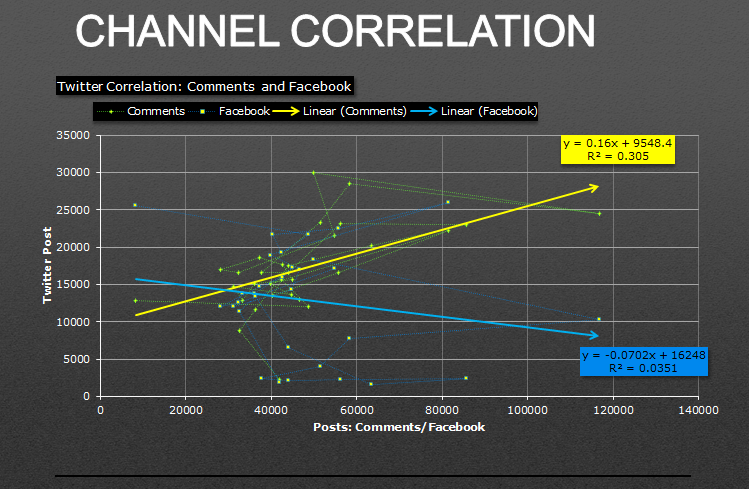
Twitter and it’s Correlation to Facebook and Media Comments: GOP Primaries

The Chart shows the correlation of Media comments and Facebook posts, in reaction to Twitter output , in regards to GOP primary Candidates. It’s no surprise there is a downward trend for Facebook. The two channels tend to be segregated politically. Twitter being more conservative and Facebook being more liberal.

Sentiment Analysis: Why is it important?

WHY IS ONLINE MEDIA IMPORTANT TO LOOK AT?

I examine this question with the help of Charts and the EU. Thank you..Click on the Charts to make them bigger.

So why is looking at on-line media important? The chart above (Lau, 2001) shows online media has expanded in the last 16 years. Online news has displaced print and broadcast to represent 46 percent of all content monitored globally. Increasingly online communications/media is becoming the main source of people’s knowledge for political affairs. In the era of the mediatization in politics and democratic theory, which assumes that an informed and attentive public is necessary for democracy to work effectively (Lau, 2001), understanding on-line communications is vital.

The Analysis of on-line media is a cross between what’s called data science[1] and “Culturomics” (Leetaru, September 2011). The goal is to find cultural trends through computerized analysis of online media to develop insights in the functioning of human society, thoughts and actions (Michel, et al., 2011). This process has been very accurate in forecasting instances such as box office sales (Mishne and Glance, 2006) to the stock market (Bollen, et al., 2011). To illustrate the power of data science and sentiment analysis in a political context scientist – using a super computer, applied tone and geographic analysis to a 30 year worldwide news archive. The scientist were able to forecast the revolutions in Tunisia, Egypt, and Libya, the removal of Egyptian President Mubarak, the stability of Saudi Arabia, and estimated Osama Bin Laden’s hiding place within a 200–kilometer radius, in Northern Pakistan.

The point of all of this?

Media is a very accurate source for insights into the human condition, as well as our thought process. Now with the rapid expansion of online media, there is a wealth of untapped knowledge and syntax to further analyse.

EXAMPLE:
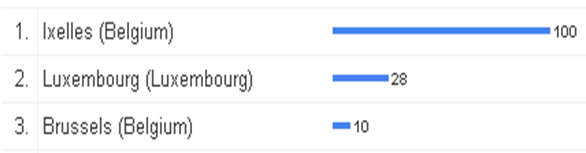
The chart above shows the volume of searches based on the terms “European Parliament”, “European Commission” and “European Union”. They were also translated into French, German and Italian for further accuracy. The data was gathered with Google Insights[1] for Search. The chart does not track positive or negative sentiment, just the volume of the terms searched through Google[2]. The data clearly shows the interest in the EU has gone down since 2004. For both the European Parliament and Commission the top locations for the searches of the term were Ixelles, Luxembourg and Brussels – all home to the institutions themselves. This illustrates the “Brussels Bubble” that so many talk about
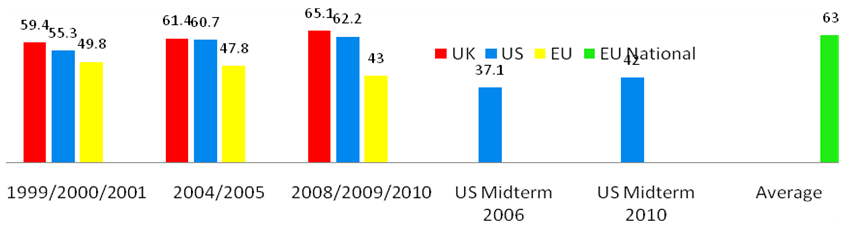
The Google insights data mirrors voting rates. In other words, voting rates (above) and participation have gone down.
The variables:
  • Lack of a unified media, hesitation on real-time engagement, failure to leverage modern instruments and an incentive to do so.
  • MEP and political parties do not have to raise money for re-election, and there is little incentive to actively engage constituents, on an individual MEP level as well since the parties puts forth the Politicians.
This frame work has lead to autonomy and citizens that look more toward national politics for answers. With the current financial “Euro” crisis it would be easy to assume that the interest in the EU – whether good or bad, would go up. This has not happened.

[1] With Google Insights for Search, you can compare search volume patterns across specific regions, categories, time frames and properties. See examples of how you can use Google Insights for Search.

[2] Google’s search market share in Europe is around 90%. In the U.S. it’s around 65%.


[1] The profession of interpreting and creating value from Data.