Active Communications

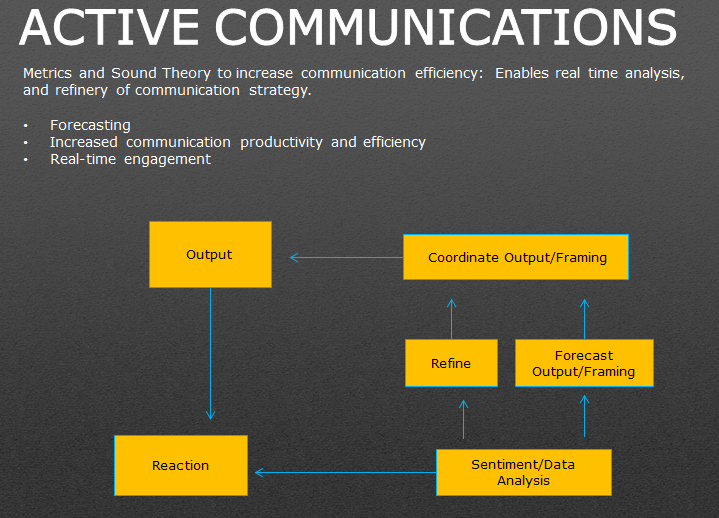
The idea of “Active Communications”  is based heavily on media monitoring listening data AND proper framing, which is a bit of an art (unless you have first class AI/NPL skills) . To work efficiently, a multi-channel infrastructure that allows for real-time content is paramount.

Important concepts to take away:

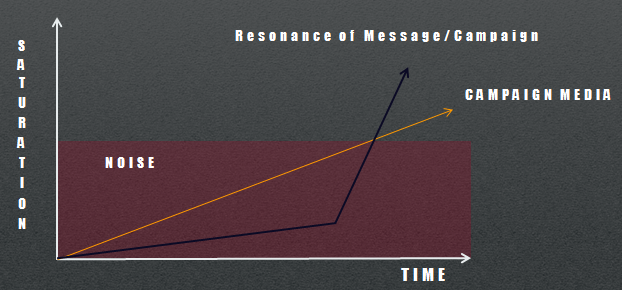
  • Timing and message coherency, to create a critical mass.
  • Trust the data for real time decision making.
  • Location based targeting with Fundamental,Technical and Sentiment analysis, per channel/medium.

Perhaps the biggest aspect is willingness to abandon prior methods after the data is received. You might be more comfortable with Twitter or another channel, but for the specific campaign it could be a  waste of time. Don’t fight up stream.
NLP: Value Greater than just Positive and Negative Sentiment.

Positive (P) and negative (N) sentiment are just transmitting two results based on many other variables. This in itself contains little knowledge. For creating strategy, it can only bench mark after the fact.

Inherently the use of data is to make better decisions for the future. Production is expensive and time consuming. So is deductive reasoning.  The main goals should be to move away from adjusting to the end reaction and migrate to a predictive model. Look at the context in higher resolution i.e. control for  variables which lead to PN sentiment.

Here are some suggestions

  • Time of day
  • Medium (Twitter,Facebook ,Blogs, Mainstream news)
  • Comments PN sentiment
  • New dissemination to comment count (time, PN)

If you are advanced, use NLP tools that allow for custom taxonomies – within the NLP,  to create rules on varibels like types of framing. On a medium level this is very good at prediction, but more on that later.

Ciao

Critical Mass

This trend is looking at analytics of political instances of media saturation. I call it Critical Mass. Despite consistent media we only see exponential gains on key events (Voting Day,Debates). This means we need to have the media infrastructure/network in place before we need it.
Possible reasons for this is:
  • Humans outsourcing knowledge to calendars, social sites and other mediums. We only know a vague amount of information and rely on our knowledge to access it as a substitute for remembering.
  • In a 24/7 multimedia cycle humans compartmentalizing knowledge to avoid over load.