Your next firm should be an IT firm.

I’ve interviewed with them all. The big firms, the small firms. Both in Brussels and in New York.

After working in the European Commission and Parliament, I wanted to go to the private side of Communications and Policy. The problem? I had been running data and insights. Using terms like NLPSentiment analysis, cognitive science and connotation mapping to describe what I did not work well. On the other hand dumbing down would leave me looking like another 27 year old who does “the social media” and or “the internets”. Most firms doing the interview for analytics positions wanted to hear “pivot table”, “engagement”, “influence” and maybe SPSS. Upping the hierarchy on those terms to explain why “something was” appeared unnecessary and impractical since explaining this to a clients communications director is another task with in itself.

So to hell with the PA/PR firms, I joined an IT firm that also does communications – Intrasoft International, and could not be happier.  The people’s skill sets are well defined and paid, which gives them a certain confidence in contrast. They like things such as analytics and completely understand them. Their only fault is the soft side of Communications – which is now my job to merge.

IT is going to take over communications sooner than later. Current  PR firms will be left scrambling. The lack of investment in the deeper meaning (abstract knowledge such as transference, retention and pragmatics) will start to show as data/connotation mining becomes a standard practice. Most IT firms already have this infrastructure in place via their AI departments.

There will be a point where dropping shit jargon is irrelevant and companies Comm Director, who should be more of a CIO/CTO in the nearer future, will see right though it.

My 2 cents. Also check out my presentation at chandlerthomas.com

CT

German EPP MEP Disconnect

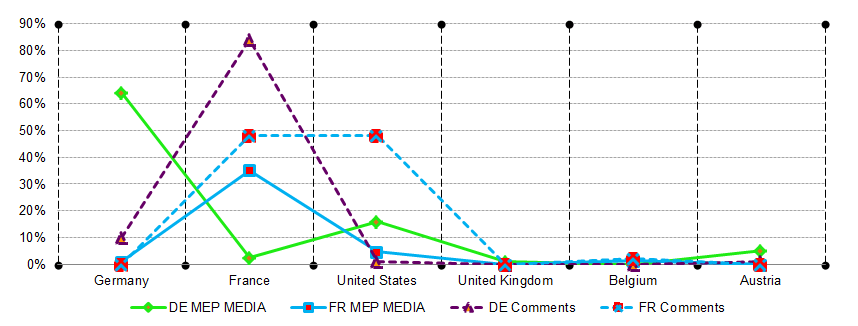
Regional online media engagement  for  German and French EPP MEP’s:  The chart clearly illustrates Germany is not engaged with their European Parliament representation, or better, the MEPs are clearly not in touch with their constituents. Can someone say democratic deficit?

•64% of German EPP MEP media is coming from Germany.
•84% of commented media on German MEP’s is from France.
•Germany only accounts for only 10% of comments of  it’s MEPs.
•Germany  does not comment on  French EPP MEPs (0%).
•French EPP MEP comments are from the USA and France (both 48%) and Belgium at 2%.

Twitter and it’s Correlation to Facebook and Media Comments: GOP Primaries

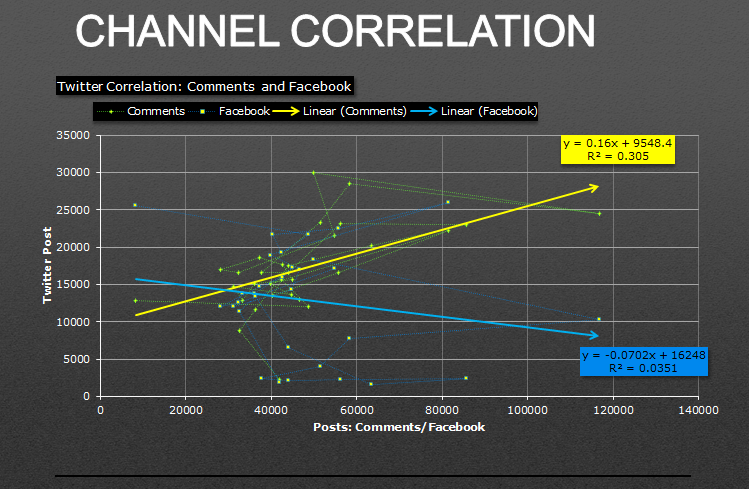
The Chart shows the correlation of Media comments and Facebook posts, in reaction to Twitter output , in regards to GOP primary Candidates. It’s no surprise there is a downward trend for Facebook. The two channels tend to be segregated politically. Twitter being more conservative and Facebook being more liberal.

Active Communications

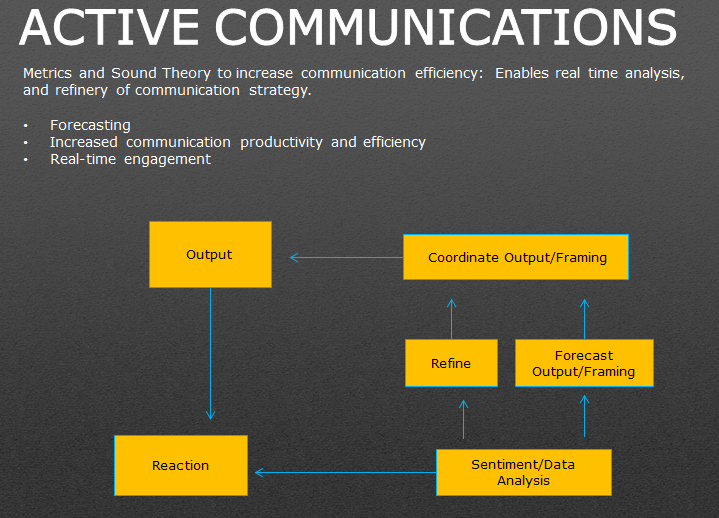
The idea of “Active Communications”  is based heavily on media monitoring listening data AND proper framing, which is a bit of an art (unless you have first class AI/NPL skills) . To work efficiently, a multi-channel infrastructure that allows for real-time content is paramount.

Important concepts to take away:

  • Timing and message coherency, to create a critical mass.
  • Trust the data for real time decision making.
  • Location based targeting with Fundamental,Technical and Sentiment analysis, per channel/medium.

Perhaps the biggest aspect is willingness to abandon prior methods after the data is received. You might be more comfortable with Twitter or another channel, but for the specific campaign it could be a  waste of time. Don’t fight up stream.

NLP: Value Greater than just Positive and Negative Sentiment.

Positive (P) and negative (N) sentiment are just transmitting two results based on many other variables. This in itself contains little knowledge. For creating strategy, it can only bench mark after the fact.

Inherently the use of data is to make better decisions for the future. Production is expensive and time consuming. So is deductive reasoning.  The main goals should be to move away from adjusting to the end reaction and migrate to a predictive model. Look at the context in higher resolution i.e. control for  variables which lead to PN sentiment.

Here are some suggestions

  • Time of day
  • Medium (Twitter,Facebook ,Blogs, Mainstream news)
  • Comments PN sentiment
  • New dissemination to comment count (time, PN)

If you are advanced, use NLP tools that allow for custom taxonomies – within the NLP,  to create rules on varibels like types of framing. On a medium level this is very good at prediction, but more on that later.

Ciao

Heuristics, Algorithms and Communications: Quick Thoughts

The use of heuristic and taxonomy algorithms for identifying cognitive bias in  communications is a game changer.  According to SAS,  companies that invest in analytics out perform the S&P500 by 64%. I imagine the margin for communication/marketing firms is greater. The market is not anywhere close to mature, and is lopsided to a few in the know. The rest toil in mediocracy via old connections/business that will surely run ground soon.
Today’s great business’s – for the most part, are data driven. Communications is perceived  to be educated guessing.. The use of programming for bias is important because bias cannot be out run. Think of this much like “Inception” and Moneyball combined.

Thanks to social networks we have the largest focus group in history. Analysts can see what people are using to explain how they feel and think – during  specific situations or events. This can also tell  how people interact within context of syntax or an instances. Very powerful and cheap information in contrast to polling or focus groups.

There are patterns/norms with how people engage on each medium. In addition to what type of syntax they use to convey a certain type of  thought. This is all programmed in the mind for the most part. Linguist like Lakoff and Chomsky suggest that brains are hard wired to favor certain patterns that convey meaning. This plays out accurately on-line consistently.

Just a random Sunday thought…Now looking forward to watching the NFL playoffs.

Ciao

Market Shares and Topic Correlations: European Parliament Party Leadership

The chart above shows how much associated EP Group  leaders have on a variety of EU topics market share of the leaders on different subjects, including their own party. It’s possible that all leaders can be in more than one article so the totals can be over 100%.  The Green line rank the subjects of all the leaders combined. The EU ranks 1st followed by the Parliament – which should be expected, and then the Euro. Joseph Daul (JD) has the most association for the EPP Group at 81%, which is a good indicator for further party branding but not for pan EU leadership , where he lags behind all others.

On the far right, the chart shows the average and over/under performance to the market share compared to Group Parliament seats.

  • Guy Verhoftstadt (GV) (ALDE) is +7,
  • Martin Schulz (MS) (S&D) is + 20
  • Joseph Daul  (EPP) is at -20.

This does not fare well for the EPP Group. When looking at the market shares of EP leaders in context to one another, JD is consistently in last place. Why does the EPP vastly underperform while the S&D and ALDE over perform? This can be due to a number of reasons.

  • JD does not speak English
  • The EPP being the largest group cannot utilize polarizing and thus mobilizing language without alienating many of their MEP’s.
  •  JD has chosen to stay out of the spotlight given that Jose Barroso and Herman Van Rompuy[1] are EPP.
  • MS is from Germany which is heavily discussed at the moment, and will also become the new President of the European Parliament replacing Jerzey Buzek[2].

Robert Fitzhenery (Head of EPP Group Press and who controls the communications and outreach budget) explained to me that the EPP Group cannot be too polarizing on political issues because of it’s size, and cannot risk alienating some MEPs. On the other end some in the Group want to be more polarizing to mobilize debate and heighten the Groups profile.

During my work with the EPP, ALDE and GV typically lead market shares on media despite only having an 11% (88 of 754 MEP seats) market share of the Parliament[3]. I talked with Neil Corlett, Head of Press and Communication for ALDE. Neil explained since ALDE was a smaller group, they decided to follow whatever GV wanted and not deviate from a few main points. In short their message is consistent via both GV and ALDE’s MEPs. It paid off. ALDE is outperforming the EPP and S&D. And both have more money. It’s only in the last two months that MS has been generating so much sentiment. It will be interesting to see if this approach pays off in the 2014 EP elections. It will also be a good indicator of how mature the on-line EU landscape is.

Communications as Productivity

By looking at Communications in terms of production and variables, you will save millions. By not understanding variables in communications, you will loose millions and time. Gone where communication firms can pass  Bullshit. Now it’s far from an art form with metrics. Clients should expect decision making based on sound research, in addition to  web analytics and online monitoring data.

The goal: Create the most productive syntax, which could be words, photos,video or interactive digital content. Not the most view and clicks

Resonance: 

Output time/date to channel dissemination, and how much time  that takes. It shows language adoption, which is how you win. There’s a saying politics, “Win the language battle, win the war”.  Resonance is a good KPI for knowing if the framing has retention, thus productivity.

Its can also be useful to reverse engineer a past event’s content and framing with machine learning to compare and contrast. Again don’t focus too much on “click and looks”. You might see exponential gain which perhaps are linked to offline events. That way you can also map correlation. I tend to see this pattern a lot working in politics. This reiterates the massive amount of information available on-line by listening.

More Tricks:

Use best practices in cognitive ICT, psychology,linguistics and behavior economics. A real expert will know captology, sentiment analysis and gamification, and not neglect fundamental and technical analysis.

When you understand the basic variables, you see that  each enhances or destroys productivity.

If the person you hired  doesn’t understand what I’m talking about, the strategy will loose productivity. Ask yourself, why we are paying 200-300 plus per hour? Educated guessing is over. The data doesn’t lie.