Click here for a link to a presentation I did about analytics. Preview Below.

Looking at strategy & markets through data science and machine intelligence.
Click here for a link to a presentation I did about analytics. Preview Below.
In the global political environment a holistic view is needed.
The standard for message delivery is high in the modern media environments. It’s vital to create communications that people identify and empathize with. The threshold to get attention, and to get people to retain your information, is even higher. Politics now competes with Pepsi, Nike and Apple. No one will take time to care about your views or propositions. Firms must be proactive in both controlling and framing language, as well as marginalizing their communication and political strategy for efficiency.
The problem: There are many variables to consider when developing productive communication and political strategies. Further, basing decisions on just educated guessing, even for the most highly skilled and experienced professional, does not meet the standards of modern business practices, which use analytics to make decisions.
The Solution: Online media provides an immense amount of information which can be monitored. The data can be used to track political and policy instances qualitatively, as well as forecast.
To do this, we must synthesize research in cognitive linguistics and Natural Language Processing (NLP). In the last few years these technologies have evolved to the point where pragmatics can be quantified accurately. And further, because of the amount of data an average person creates in a day, we have and endless amount of information to drill down into for examining political and cultural phenomenon.
I’m currently looking at the French elections. There will be more on that and this in a bit.
Unfortunately the high cost of doing business – taxes, labour laws and questionable professional standards across all member states, threatens to marginalizes the EU between Asia and the US.
USA= Innovation, quick to adapt, dynamic work force, large integrated market.
Asia = Cheap labour, willingness to adapt, on the up and up.
The main issue is hesitation to adopt any new methods. In a knowledge economy such as the EU, liquidity of knowledge is a huge asset. None the less, as we see from the data debate, there are only worries and fears, no positives. This is partly Google and Facebook’s fault for not controlling the debate better, although with the cultural differences, I’m not sure it matters.
What ever side of the debate you are on, there is no way the Commission/Parliament will be able to regulate at the speed that such companies innovate and develop new technologies.
I liken it to a scenario:
Jose is trying to learn how to get a date. He decided to go to a conference at a hotel that explains how to do this. On his way to the room where the conference was being held, Jose encounters two doors. One leads to the conference on how to pick up a date. The other door has a sign that says “Successful single women’s conference. Please join us for a drink. Anyone is welcome”. Jose chooses the first door as he had planned, and continued learning and taking notes about how to get a date. The EU relationship with Technology is a lot like Jose’s approach to picking up a date, hesitant and unwilling to adapt in real-time, to the peril of the end goal.
In October I was giving a presentation about on-line media, trend, and sentiment analysis/monitoring to institution officials. During the presentation I was asked “why do we need to understand what people are saying about us?” Admittedly I was a bit shocked. Interest in the EU has gone down every year since 2004 http://ow.ly/8w2Gs, as well as voting rates. In my view a good place to start building a proper message that mobilizes people, is to find out how people perceive and talk about you in the first place. Thinking about the institution officials statement further, I concluded the real issue wasn’t that that online monitoring couldn’t be useful for their goals, but it would have created a real-time approach, the antithesis of the institutional process Europe is familiar with. The incentive wasn’t there either.
In the globalized future hesitation is dead, improvisation is king, and competition will be fierce. Both EU firms and institutions spend too much time discussing what technologies such as social media mean or can do but never act. On the opposite, competition is the USA led to elections becoming a science. The 2012 campaigns will feature natural language processing, text mining, sentiment analysis, and data scientists. These technologies will marginalize every medium and word. There will be no room for “educated guessing”. This is efficient and saves time and money. Further it may help yield larger voter turnout as did the 2008 U.S. elections. Forward to the EU. The system is not competitive. The money is provided by the public, and the European Commission is in charge of getting people to vote with a neutral message. And they are still having conferences about what social media means.The future will embrace adaptability and change, you don’t get the luxury of writing a 10,000 word strategy paper, or a controlled institutional process, life and business move too fast. If the EU is going to have a chance using technology to it’s full advantage , it must first take a shot, and ask it out on a date.
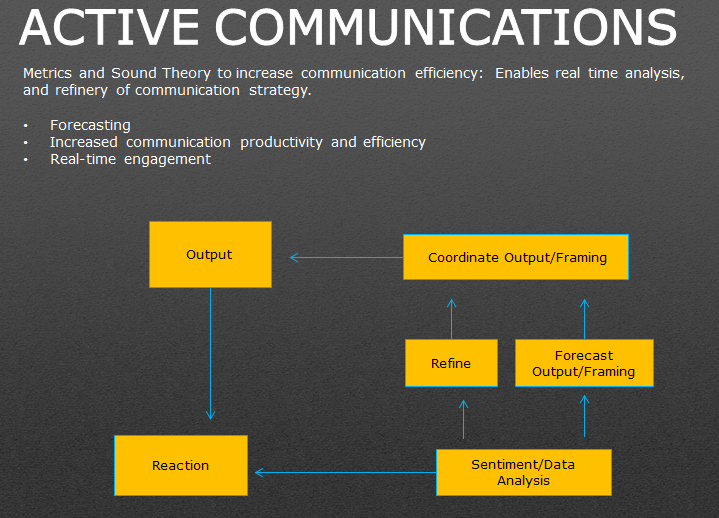
The idea of “Active Communications” is based heavily on media monitoring listening data AND proper framing, which is a bit of an art (unless you have first class AI/NPL skills) . To work efficiently, a multi-channel infrastructure that allows for real-time content is paramount.
Important concepts to take away:
Perhaps the biggest aspect is willingness to abandon prior methods after the data is received. You might be more comfortable with Twitter or another channel, but for the specific campaign it could be a waste of time. Don’t fight up stream.
Positive (P) and negative (N) sentiment are just transmitting two results based on many other variables. This in itself contains little knowledge. For creating strategy, it can only bench mark after the fact.
Inherently the use of data is to make better decisions for the future. Production is expensive and time consuming. So is deductive reasoning. The main goals should be to move away from adjusting to the end reaction and migrate to a predictive model. Look at the context in higher resolution i.e. control for variables which lead to PN sentiment.
Here are some suggestions
If you are advanced, use NLP tools that allow for custom taxonomies – within the NLP, to create rules on varibels like types of framing. On a medium level this is very good at prediction, but more on that later.
Ciao
I thought that I would post a trend chart that I found. It is from the 2011 summer of rebellion. Please ask questions:

Thanks to social networks we have the largest focus group in history. Analysts can see what people are using to explain how they feel and think – during specific situations or events. This can also tell how people interact within context of syntax or an instances. Very powerful and cheap information in contrast to polling or focus groups.
There are patterns/norms with how people engage on each medium. In addition to what type of syntax they use to convey a certain type of thought. This is all programmed in the mind for the most part. Linguist like Lakoff and Chomsky suggest that brains are hard wired to favor certain patterns that convey meaning. This plays out accurately on-line consistently.
Just a random Sunday thought…Now looking forward to watching the NFL playoffs.
“The race is for a system digital currency wield the most social influence. One particular player has emerged, Klout, determined to establish their platform as the authority of digital influence. Klout’s attempt to convert digital influence into business value underscores a much bigger movement which we’ll continue to see play out in the next year. To some degree everyone now has some digital influence (not just celebrities, academics, policy makers or those who sway public opinion). But for the next year, the cult of influence becomes less about consumer plays like Klout and more about the tools and techniques professionals use to “score” digital influence and actually harness, scale and measure the results of it.”
– Just use Klout for Accountability. If the communications Unit’s goal is to get online, Klout can be a good way to hold people accountable. Nothing more at this point but there seems to be potential.
 Machine Lens