With the Greece/Eurozone situation reaching the brink, I decided to take a look at what’s been happening over the past week within the European Parliament domain.
Some takeaways after I extracted the top people and issues:
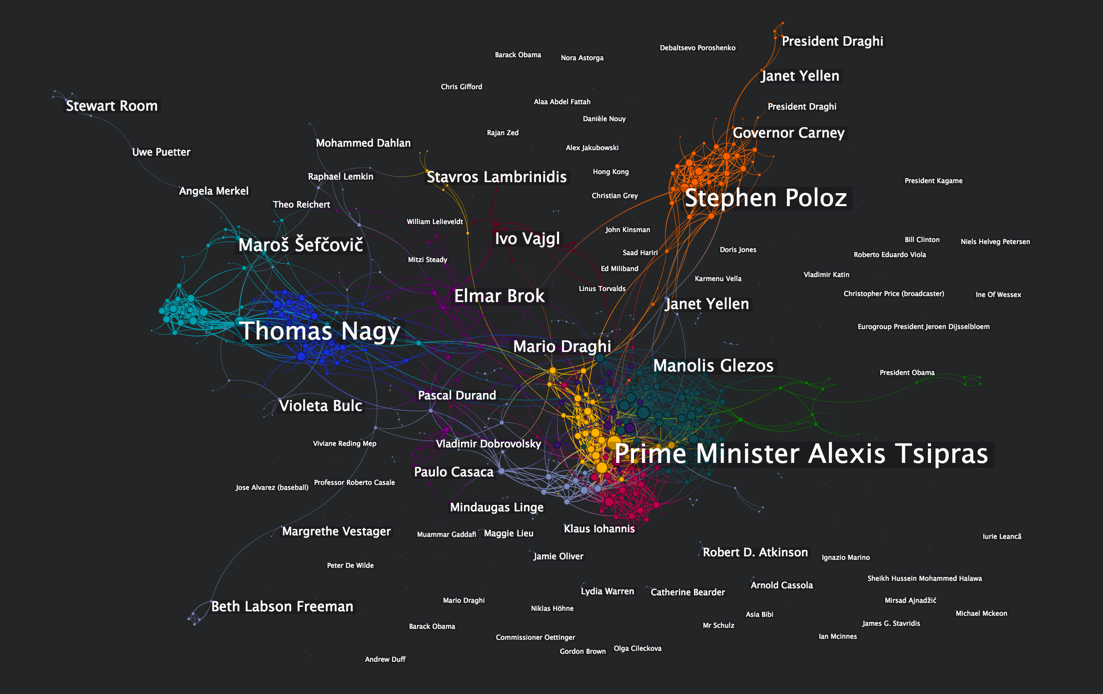
- The Eurozone, Yellen’s decision to be patient with the Fed and housing markets are interlinked (not a surprise), indicating US businesses should be mindful of the Greek debt restructuring. This has affected foreign exchange markets and the domestic retail sector a bit.
- Outside of global finance and the Greek debt restructuring, the European Parliament’s decision to back new limits for food based bio-fuels was the most embedded policy instance. Thomas Nagy, EVP at Novozymes and the most central person to the policy, had this to say: “A stable and effective framework is the only way forward to secure commercial deployment”.
- Climate change and carbon trading (to be reformed in 2018) were most central to the new policy, as well as the EU plans to merge energy markets, which ALDE feels “will be a nightmare for Putin” and weaken Russian grip on Europe’s energy needs.
The bar chart below shows which topics within the European Parliament domain are associated with each person. The people are represented by the colors from the network graph above. It’s in hierarchical form based on centrality (to the European Parliament).

Something to be cognizant of: Data Protection
While the issues are on the edge of EU affairs, as indicated at the top left and bottom right of the network graph below (highlighted in the teal green and dark red), data issues are becoming embedded within the broader scope of the EU Parliament. Note that the range is across network centrality. This indicates that policies will have to be negotiated within a multitude of domains.
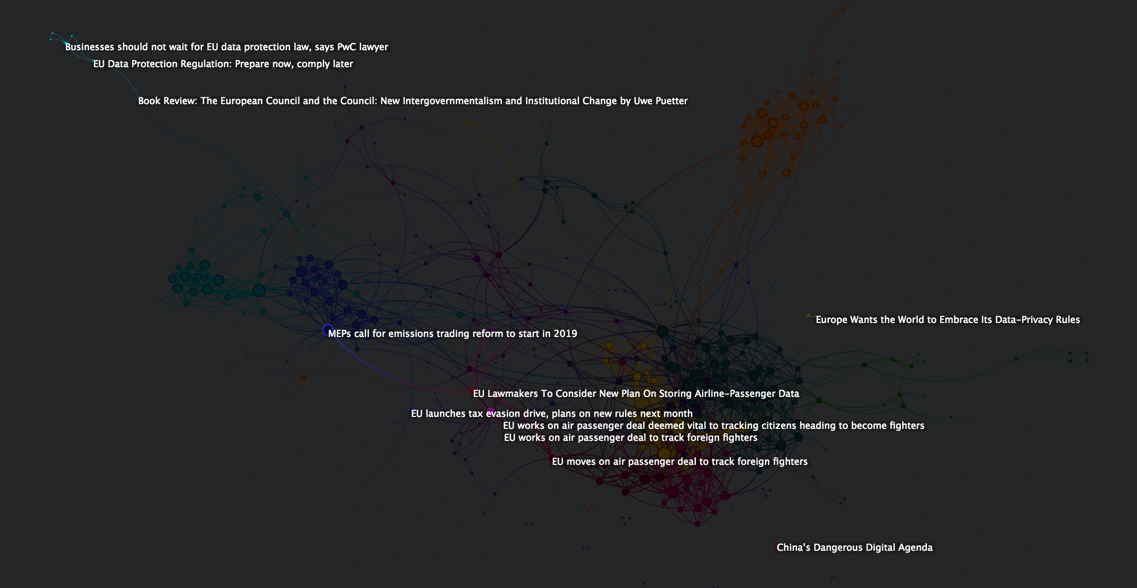
Stewart Room, a partner at PwC Legal, warns “businesses that are waiting for the EU General Data Protection Regulation (GDPR) before taking action have already missed the boat.” I agree. Companies will need to be cognizant of the European Union’s penchant to regulate data and technology, often before understanding it.
Multi-sector coalitions have to be built. Framing legislation within global policy that is both considerate to business efficiency, yet empathetic to consumer concerns for privacy, could help avoid the backlash that ACTA and SOPA felt. Data means too much to business. If not addressed in a thoughtful way, it could end up being the Trojan horse to TTIP and TPP and push those negotiations, and therefore economies, backwards.
Isn’t it cool how we can mine and extrapolate information from open source data for strategic intelligence? Much more contextual than Googling everything. Also it illustrates just how interlinked the world has become.
-CT







 Machine Lens
