I decided to break down the events of John Kerry visit to Jose Barroso. The reactions are not drastic as I would have thought considering GMO’s and IP are two issues that people care about on both continents, and the Free Trade Agreement is making some actual headway. We will have more on this in the future, but here are small bits of data for starters
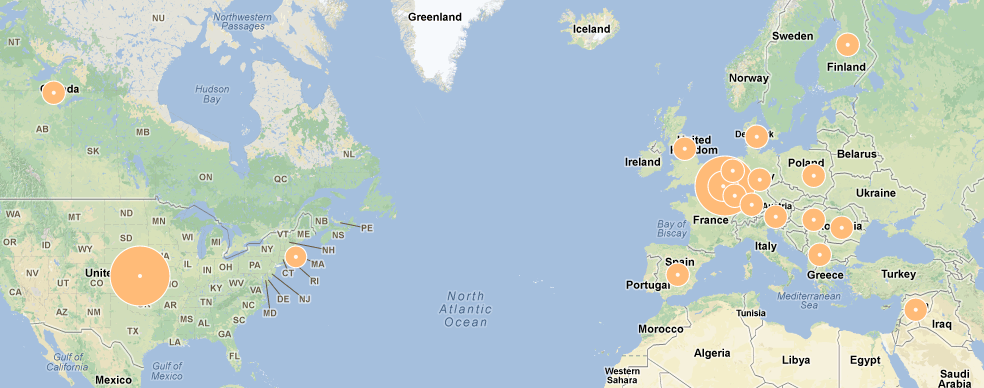
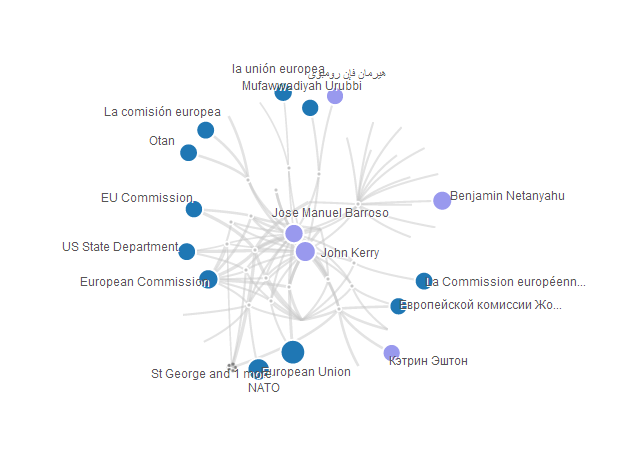
We see that the reporting on the John Kerry and Baroso event is reported on in Brussels 33 times – much more than any other area except for the entire US. Below we see events with organizations and people that both of them together are tied to.
Cross referencing what each leader said within the context above is where it gets interesting. Questions to ask: Who were their targets? Did they attain any impact?
When I first arrived to Brussels I was always amazed at how disconnected D.C was from Brussels with that I decided to look at who was following who. We see that only 1.1% follow both. In short they are disconnected networks. For Comparison sake I also did Obama V Barroso but since Obama has over 30 million follower, the tools I was using at the moment couldn’t process such large amounts of data.
Jose is trying to learn how to get a date . There’s a conference at a local hotel on how to pick up women. On his way to the room, Jose’ encounters two doors. One leads to the conference taught by men on how to pick up girls. The other door has a sign that says “Successful single women’s conference. Please join us for a drink, anyone is welcome”. Jose chooses the first door as he had planned, and continues learning about how to pick up women. The EU relationship with using technology is like Jose’s approach to trying to pick up women, hesitation and unwillingness to adapt in real-time, to the peril of the end goal – i.e. institutional.
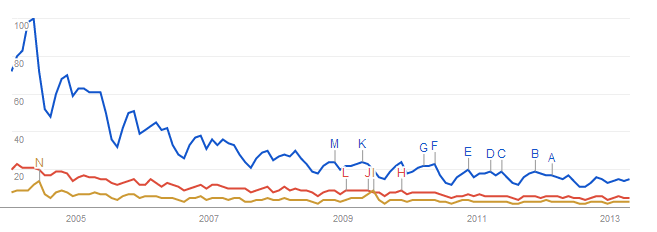
One day I was talking about online media monitoring to the institutions “social media expert”. I was asked “why do we need to understand what people are saying about us?” I was shocked and had no answer except to point out Interest in the EU has gone down every year since 2004 http://ow.ly/8w2Gs. Specifically alarming was that the Parliament, which is supposed to be the extension of the people, had the lowest interest rate.
Blue – European Union Red – European Commission Yellow – European Parliament
Now having worked in US politics, a good place to start making a more legitimate government, is being more representative of constituents..and understanding what people are saying about you allows you to create better policies and messages that can help engage people, and perhaps increase the voting rates.
Both EU firms and institutions spend way too much time discussing what technology such as social media is, or what it means, but never act. For example Friends of Europe just released a paper about social media . Frankly I found it pointless, uninteresting, and six years too late.
In the globalized future hesitation is dead, improvisation is king, and competition will be fierce…
Thinking about the “social media experts” statement further, I concluded it wasn’t that online monitoring wasn’t useful for their situation, but it’s use would have created a real-time approach. This is the antithesis of institutional process Europe is way too familiar and comfortable with. And incentive for the people working in the institutions wasn’t there either.
In the USA, competition has led to campaigns and politics becoming a science. And voting rates + political involvement have gone up.
The 2012 campaigns featured natural language processing, text mining, sentiment analysis, and data scientists. These technologies will marginalize every medium and word. There was no room for “educated guessing”. This is efficient, saves time and money, plus leaves the politicians to focus on empathizing more with the electorate. Forward to the EU. The system is not competitive. The money is provided by the public, and the European Commission is in charge of mobilizing people in a non-political way, which is inherently very, very difficult.
The future will embrace non-understanding, chaos and real-time data, you don’t get the luxury of writing a 10,000 word strategy paper. At present the EU mindset is not equipped to handle this transition. It must remember if it wants to hang out with future technology, it has to first quit talking, and ask it out on a date.
Much of this post was taken from a comment I wrote on LinkedIn in which I talked about vision and corporate culture (http://goo.gl/UIwUv). While a lot has been said of “corporate culture”, most of the time this is under the guise of CSR reforms and other similar bullshit jargon. Being a data man who relies on sound principles, I fully agree that an internal focus from leadership is essential. For change that “takes” there needs to be an internal process and protocol set that reinforces the change in addition to clear incentives and goals. In other words, make it so you can’t get out of it. It’s also important to remember that setting out and visualizing a corporate culture is often times different than building a sustainable and profitable culture that makes bleeding edge solutions and products that people and companies want to buy.
What I find painfully obvious, and a huge risk to building a sustainable corporate culture that breeds future relevance, is that lack of perspective and group thinking tend to build off one another. These are the banes of any culture seeking to be relevant and innovative in the highly competitive, interconnected, but often times different enough world.
Think about this: The majority of leaders and directors come from the same schools, have the same frame of mind and generally have had an upward linear career path that was safe. They went to the best schools, got good grades and were very smart. While intelligence and capability are no doubt quality prerequisites and parts of the solution, companies will inherently lack “grit” and suffer opportunity loss for the intellectual capital gained from it (Good article on grit http://goo.gl/W8Dxj) . Ultimately, the perspective that is essential for good decision making is affected (McKinsey; Kahneman and Klein article on this http://goo.gl/0bFcC). I find grit and perspective to be the main bottle necks in building a company culture that embraces disruption and leverages it fast, the holy grail of most of this research. So with that I challenge leaders to step up and get real with developing “corporate culture” legitimately (diverse/non group think environment) so it isn’t in parentheses as it often is.
Bring in fuck-ups so you don’t fuck up. People you might not be comfortable with and you don’t get right away. They might not have gone to the right schools, and might be a bit crazy, but have succeeded in unique ways that make you question your job, skills and thinking. You might find you are not relevant. This is obviously scary to people, but it’s necessary to motivate them into learning new skills, in addition to creating a “check down” in the corporate process that maintains innovation and relevance.
From October 25 -> December 4th there were 20,022 Tweets Containing the words European Union, European Parliament and European Commission. This means tweets were quite specific and could not be mistaken for anything else, further of course the majority of posts were in English, although more than 30 languages were represented. Many of the quick findings reinforce numerous Social Network Analysis studies which show that most network opinions and frames are controlled by a minority of people – between 10-20% i.e. elite level. Social media, despite a lot of hype, has not changed this.
The context surrounding these 20K Tweets
Were produced by 13,832 accounts
Retweets made up 28% of all Tweets
The Top 18 Tweets – in terms of most retweeted, made up 9% of all tweets
Top 18 Tweets that made up 9% of all tweets were made by 11 accounts
The most visible and retweeted Tweet was a coalition with FC Barcelona (below) – ( This leaves me to question why are there not more collaborations between the public and private sector in the EU?)
Top Accounts from Top 18 Tweets:
Wikileaks – 6 Tweets in Top 18 (33%)
Economist – 2 tweets in top 18 (11%)
Top Users commenting on the Euro. UKIP is seems to be taking a proactive approach to framing it’s primary fodder against the EU (the Euro Crisis).
I run my own technology and communications consulting business with clients in BeLux and USA at 28 years old, I’m from the USA. I’ve consistently see the EU always aiming to train people as a solution to get itself out of the economic hardship it’s experiencing..
Education sure, great – to some extent, but I’m not sold.. lower taxes – more cash on hand to spend on opportunities that pop up is essential, and less stress on those who are starting a business is key. 70% of wealth is inherited in BE for example, and I was further amazed to hear the horribly run government here has the audacity to decided if you are competent to run a business. As if it’s competent to decide anything itself, which it’s not. This is where EU federalism could step in, make things more liquid and really make a difference.
Further EU citizens must come to grips that in order to make aggressive progress there are inherent risks involved… back to EDU – I’m skeptical that institutions can provide any relevant training – especially in Europe which is is run by institutions. Nothing here has really been created and perfected on globally competitive level for years in new fields – not one EU tech company is in the top 10 for example. Nokia is 13 and failing harder and harder as the world/business moves faster and faster. Perhaps that is chance, but perhaps EU society is not well equipped to deal with the adversity and speed of modern business because it rely so heavily on ingrained “training, education” which has created a lot of over head and diluted what the word talent actually means , being educated or being really good at something are more often than not different. When I see “According to the plan” is part of the idea – and as a business owner knowing plans never go according to plan. A focus on knowledge management and handling adversity is key, but very difficult to create a curriculum, it needs to be ingrained in the culture of progress and risk is fun, don’t look back.
In general entrepreneurs such as myself carry a bit of disdain for institutional process and tradition, something tightly ingrained in European culture. All the great modern, dynamic companies were basically and for the most part built by institutional dropouts, failures or pure genius which never had a need for them. In France your career track and whether you go to HEC or ScPo is decided at 10 or so years old. Think of the opportunity loss on intellectual capital, for what in general is a partially false knowledge system propped up by a robust, far reaching institutional system. For any federal system such as the EU, that has aspiration of being reverent/competitive on the global level this should be considered unacceptable. Nonetheless this outlook is perpetuated in EU society. The first thing I’m asked after I explain what I do is where was I educated, as if it matters, I learned nothing from education that I do now – I run my business off my own Ideas not others – this is how business grow/succeed, not repeating and learning from the very people, ideas, and institutions that created the problems in the first place. Take a look at the past, take what is needed,continuously improve and prove your own ideas wrong. Never settle.
Some quick thoughts about what I think is inhibiting the progress of mankind and discrediting my profession.
NLP“Neuro-linguistic programming”
For some reason this “woo” keeps coming up at communication events. Lets stop the hippie feel good stuff and get on with business. You are not a doctor. Do not give credence to feel good jargon and pass it off like science. We are all dumber for hearing these ideas. Yes, I am brain washed by my western medicine, and strict materialist atheist views.. and much better for it.
The terms Savvy/Buzz/Engagement/Guru
People should have to sit through a presentation that they are supposed to take serious and hear these painful terms. It should be assumed and implied if you are professional you will get people to interact with your content, not engage, other wise why the hell are people paying you? Further, if I ever see such words on a CV I immediately throw it away… This is used by people who have no new ideas and or are not well researched. Let the data speak for itself. Assume people are smart. You are not special because you work in media and communications.
Obama gets a lot of blame for the economy – which is the main argument/premise. None the less. Bush was in office when the stock market crashed and the GOP controlled both the senate and house the majority of the time leading up to the crash. It wasn’t just the US that went through crisis – every nation did no matter what type of government they ran – communist, socialist, free market (many eastern EU states).
Both parties voted for the bail outs. And fortunately we are improving.
My thinking is I’m not convinced a government or anyone for that matter really has that much control over any of it.. Other wise why did it happen in the first place?
Obama is not socialist. Go to Germany, Greece, Denmark or the Richest country on earth – Norway, if you want to see what that really is..It can be a good and bad thing. I run a US company that deals a lot in Europe and have done a decent amount of business. I must state that I do not feel the “crushing burden of socialism” as I’ve heard from those in the USA – and who probably have less complex legal/tax issues that are inherently involved with doing international business. If you want to see what real problems are, come to Belgium and try and start a company dealing with their BS admin procedures ( something I get to avoid because I have a US company).
Why every Romney supporter feels Obama is the worst person in the world:
In the last four years communications have increased ten fold and created a perception of us and them. This in turn physically effects our brains frame – which is directly how you view the world and political positions. For example you think you are 100% right and the issue is 100% clear, but a democrat feels just as correct about believing the exact opposite.
While you feel divided, different and apart from a liberal or conservative, the fact is you agree on 95% of things – you can both love dogs, like sports, think people should not kill or steal from each other… Now a Political strategist job is to make you think the 5% of things you don’t agree on are the biggest fucking problems in the world.
In actuality we have never been more aligned politically, while feeling further apart. This polarization is both good and bad. And a heavily debated topic among political scientist. For one it get’s people to understand complicated issues (good). Two it brings people to the polls (good). The big “what if”, is grid lock and the tipping point between facts and perceptions. At some point policy does have consequence – both good and bad, and some are better than others.
Romney or Obama. Not much would have changed. But as I say, who wins deserves it. In this case the Obama campaign was smarter and better than Romney’s. And that’s exactly who I want to lead the country.
Any how historically the next election should go to a Republican.
Adding words to sound smart, for style points or just to make it longer, wastes time (the most important resource). I started referring to this as intellectual porn about two months ago. I must say I like the term – especially working in the EU environment, where it has multiple applications.
It’s time marketers realize people are exposed so much media noise and syntax that to stand out, it’s time to start just being direct and have a good product. Talking a lot and being “social” is most of the time fake and annoying. No one cares outside of something that is 98% relevant or actually extraordinary. Now’s the time to only be extraordinary.
I’ve interviewed with them all. The big firms, the small firms. Both in Brussels and in New York.
After working in the European Commission and Parliament, I wanted to go to the private side of Communications and Policy. The problem? I had been running data and insights. Using terms like NLP, Sentiment analysis, cognitive science and connotation mapping to describe what I did not work well. On the other hand dumbing down would leave me looking like another 27 year old who does “the social media” and or “the internets”. Most firms doing the interview for analytics positions wanted to hear “pivot table”, “engagement”, “influence” and maybe SPSS. Upping the hierarchy on those terms to explain why “something was” appeared unnecessary and impractical since explaining this to a clients communications director is another task with in itself.
So to hell with the PA/PR firms, I joined an IT firm that also does communications – Intrasoft International, and could not be happier. The people’s skill sets are well defined and paid, which gives them a certain confidence in contrast. They like things such as analytics and completely understand them. Their only fault is the soft side of Communications – which is now my job to merge.
IT is going to take over communications sooner than later. Current PR firms will be left scrambling. The lack of investment in the deeper meaning (abstract knowledge such as transference, retention and pragmatics) will start to show as data/connotation mining becomes a standard practice. Most IT firms already have this infrastructure in place via their AI departments.
There will be a point where dropping shit jargon is irrelevant and companies Comm Director, who should be more of a CIO/CTO in the nearer future, will see right though it.



 Machine Lens