OSINT One. Experts Zero.

Our traditional institutions, leaders, and experts have shown to be incapable of understanding and accounting for the multidimensionality and connectivity of systems and events. The rise of the far-right parties in Europe. The disillusionment of European Parliament elections as evidenced by voter turnout in 2009 and 2014 (despite spending more money than ever), Brexit, and now the election of Donald Trump as president of the United States of America. In short, there is little reason to trust experts without multiple data streams to contextualize and back up their hypotheses.

How could experts get it wrong? Frankly, it’s time to shift out of the conventional ways to make sense of events in the political, market, and business domains. The first variable is reimagining information from a cognitive linguistic standpoint. Probably the most neglected area in business and politics – at least within the mainstream. The basic idea? Words have meaning. Meaning generates beliefs. Beliefs create outcomes, which in turn can be quantified. The explosion of mass media, followed by identity-driven media, social media, and alternative media, is a problem, and we are at the mercy of media systems that frame our reality. If you doubt this, reference the charts below. Google Trends is deadly accurate in illustrating what is on people’s minds the most, bad or good, wins – at least when it comes to U.S. presidential elections. The saying goes bad press is good press is quantified here, as is George Lakoff’s thinking on framing and repetition (Google search trends can be used to easily see which frame is winning, BTW ).

google-search-trends-presidential-candidates-2004-to-present
Google search trends of Democrat and Republican presidential candidates going back from 2004 to 2016. The candidate with the highest search volume won in all political races.
Social media and news mentions of key 2016 presidential candidates. The query used was (
Social media and news mentions of key 2016 presidential candidates per hour within the query used “Donald Trump” OR “Hillary Clinton” OR hashtags #ElectionDay OR #Election2016.
google-search-trends-nicolas-sarkozy-franc%cc%a7ois-fillon-alain-juppe
Google Trends wasn’t caught off guard by François Fillon’s win over Nicolas Sarkozy and Alain Juppé in the French Republican primaries. It was closer than the polls expected all along.

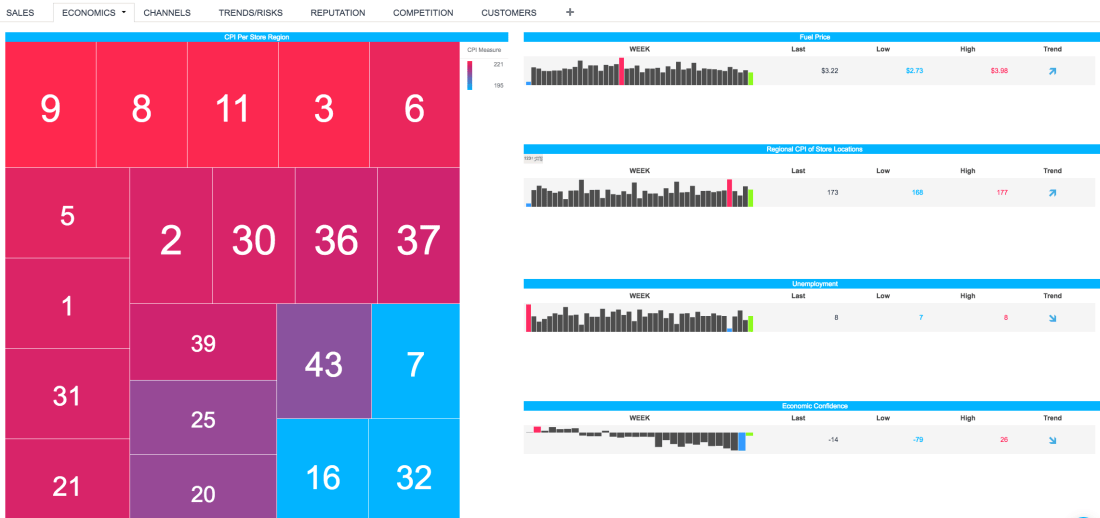
Within this system, there is little reason to challenge one’s beliefs, and almost nothing forces anyone to question their own. Institutions and old media systems used to be able to bottleneck this; they were the only ones with a soapbox, and information was reasonably slow enough. There is a need for unorthodox data, such as open-source intelligence (OSINT) and creativity, which traditional systems of measurement and strategy lack to outthink current information systems. To a fault, businesses, markets, and people strive for simple, linear, and binary solutions or answers. Unfortunately, complex systems, i.e., the world we live in, don’t dashboard into nice simple charts like the one below. The root causes of issues are ignored, untested, and contextualized, which creates only a superficial understanding of what affects business initiatives.
linear-dashboard
A nice linear BI chart is above. Unfortunately, the world is much more complex and connected – like the network graph below, which clusters together new media that covered Hillary Clinton and Donald Trump.

network-graph-of-news-media-about-donald-trump-hillary-clinton

I know this may feel like a reach in terms of how all that is mentioned is connected, so more on OSINT, data, framing, information, outcomes, and markets to come.

Cheers, Chandler

The Brexit

While investors were in shock, open source signals such as Google trends often pointed to “Leave” predominating, illustrating expert and market biases.  Perhaps they should work on integrating these unconventional data streams better (sorry couldn’t help it).  The UK’s decision to exit from the EU is part of a larger global phenomenon that could have been understood better with open source, not just market, data.

Leave Remain Google Trends
Google Search Trends on “Leave” or “Remain”

The world is growing more complex. Information is moving faster. Humans have not evolved to retain or understand this mass output of (dis) information in any logical way. As a response, a retreat to simple explanations and self-censorship towards new ideas that might challenge one’s frame are ignored and become the norm. Populist decisions are made and embraced, oftentimes reactionary towards the establishment or elite. Multi-national corporations and elites will need to step outside of their bubble and take note of nationalist, albeit sometimes isolationist, such as Donald Trump, Bernie Sanders, President Erdogan of Turkey, Marie Le Pen’s Front National of France, Boris Johnson – Former Mayor of London and Brexit backer (good chance he takes David Cameron’s place), Germany’s AFD and the 5-star movement in Italy gain in both popularity and power.

New media online coverage tagging of Leave V Remain
News media dynamics of “Leave” (Red) and “Remain.” Grey and black have no overlying preference. In addition to Google Trends, most of the media coverage focused on “Leave” over “Remain.” Those polling companies should look at framing effects to accurately conclude outcomes.
Red = People associated with Leave. Blue = people associated with Remain.

In addition to the more media coverage, more people were associated with the leave campaign, which is an advantage. During a political campaign, choices and policy lines are anything but logical; they tend to fall on emotional lines, so institutional communications must have a noticeable figurehead, especially in the media age. It says something when the top people who are associated with Remain are Barak Obama, Janet Yellen, and Christine Lagarde. Note that David Cameron is more central with leave.  Nonetheless, the pleas by political outsiders and institutions such as the IMF and World Bank for the UK to remain in the EU potentially caused damage to the “Remain” campaign. UK voters did not want to hear from foreign political elites. This is illustrated by the connection and proximity of the “Obama Red Cluster” to the French right-wing Forest Green cluster (and the results) below. The “Brexit” could lend credence to the possibility of EU exit contagion. There are very real forces in France (led by the Front National) and Italy (led by the 5 Star Movement (who just won big in elections) that are driving hard for succession from the EU and or, potentially, the Eurozone.

This network show the Brexit domain the day prior to the Leave result.
This network shows the Brexit domain the day prior to the Leave result.

Ramifications:

  • Banks (especially European ones) are fleeing to the gold market, seeking shelter from volatility. While this is to be expected, dividend-based stocks and oil would also be attractive to those seeking stability.
  • Thursday’s referendum sent global markets into turmoil. The pound plunged by a record, and the euro slid by the most since it was introduced in 1999. Historically, the British Pound reached an all-time high of 2.86 in December of 1957 and a record low of 1.05 in February of 1985.
  • Don’t count on US interest rate hikes. Yellen has expressed concern about global volatility on multiple occasions. The Brexit just added to that. The Bank of England could follow the US Fed and drop interest rates on the GBP to account for market uncertainty.
  • If aggressive, European uncertainty could allow US companies to gain on European competitors. Due to the somber mood within Europe, companies could be more conservative with investment, leaving them vulnerable.
  • Alternatively, Brexit may trigger more aggressive U.S. or global expansion by European Companies while the ramifications of Brexit are further understood.
  • The political takeaway is that the Remain campaign was relatively sterile, with no figurehead or clear policy issues directly related to the EU. This was reflected by the diversity in associated search terms related to the “Leave” campaign. In addition, Angela Merkel, not an EU leader such as European Commission President Jean-Claude Junker, was once again seen as the de facto voice of Europe.

Thoughts on the election

Obama gets a lot of  blame for the economy – which is the main argument/premise. None the less. Bush was in office when the stock market crashed and the GOP controlled both the senate and house the majority of the time leading up to the crash. It wasn’t just the US that went through crisis – every nation did no matter what type of government they ran – communist, socialist, free market (many eastern EU states).
 Both parties voted for the bail outs. And fortunately we are improving.
My thinking is I’m not convinced a government or anyone for that matter really has that much control over any of it.. Other wise why did it happen in the first place?
Obama is not socialist. Go to Germany, Greece, Denmark or  the Richest country on earth – Norway, if you want to see what that really is..It can be a good and bad thing. I run a US company that deals a lot in Europe and have done a decent amount of business. I must state that I do not feel the “crushing burden of socialism”  as I’ve heard from those in the USA – and who probably have  less complex legal/tax issues that are inherently involved with doing international business. If you want to see what real problems are, come to Belgium and try and start a company dealing with their BS admin procedures ( something I get to avoid because I have a US company).
Why every Romney supporter feels Obama is the worst person in the world:
In the last four years communications have increased ten fold and created a perception of us and them. This in turn physically effects our brains frame – which is directly how you view the world and political positions. For example you think you are 100% right and the issue is 100% clear, but a democrat feels just as correct about believing the exact opposite.
While you feel divided, different and apart from a liberal or conservative, the fact is you agree on 95% of things – you can both love dogs, like sports, think people should not kill or steal from each other… Now a Political strategist job is to make you think the 5% of things you don’t agree on are the biggest fucking problems in the world.
In actuality we have never been more aligned politically, while feeling further apart. This polarization is  both good and bad. And a heavily debated topic among political scientist. For one it get’s people to understand complicated  issues (good). Two it brings people to the polls (good). The big “what if”,  is grid lock and the tipping point between facts and perceptions. At some point policy does have consequence – both good and bad, and some are better than others.
Romney or Obama. Not much would have changed. But as I say, who wins deserves it. In this case the Obama campaign was smarter and better than Romney’s. And that’s exactly who I want to lead the country.
Any how historically the next election should go to a Republican.
– CT

Your next firm should be an IT firm.

I’ve interviewed with them all. The big firms, the small firms. Both in Brussels and in New York.

After working in the European Commission and Parliament, I wanted to go to the private side of Communications and Policy. The problem? I had been running data and insights. Using terms like NLPSentiment analysis, cognitive science and connotation mapping to describe what I did not work well. On the other hand dumbing down would leave me looking like another 27 year old who does “the social media” and or “the internets”. Most firms doing the interview for analytics positions wanted to hear “pivot table”, “engagement”, “influence” and maybe SPSS. Upping the hierarchy on those terms to explain why “something was” appeared unnecessary and impractical since explaining this to a clients communications director is another task with in itself.

So to hell with the PA/PR firms, I joined an IT firm that also does communications – Intrasoft International, and could not be happier.  The people’s skill sets are well defined and paid, which gives them a certain confidence in contrast. They like things such as analytics and completely understand them. Their only fault is the soft side of Communications – which is now my job to merge.

IT is going to take over communications sooner than later. Current  PR firms will be left scrambling. The lack of investment in the deeper meaning (abstract knowledge such as transference, retention and pragmatics) will start to show as data/connotation mining becomes a standard practice. Most IT firms already have this infrastructure in place via their AI departments.

There will be a point where dropping shit jargon is irrelevant and companies Comm Director, who should be more of a CIO/CTO in the nearer future, will see right though it.

My 2 cents. Also check out my presentation at chandlerthomas.com

CT

War Themes: News Output and Search Interest

Recently, I was doing a project to see if there was a correlation of war themed News and the Search interest. I found that there was indeed. .86 for Iraq and a .46 correlation for the strategically framed “War on Terror” language. I guess Chomsky and Lakoff are/were right. These findings are also in line with a study in 2010 by Daniela V. Dimitrova and Jesper Strömbäck. Their research concluded that U.S. Elite newspapers had higher patterns of  military conflict framing, and  used more official government and military sources. In contrast, Elite Swedish newspapers displayed more “responsibility and anti-war protest framing”, and were more critical of the war.