Analytics and the Global Political Environment

In the global political environment a holistic view is needed.

The standard for message delivery is high in the modern media environments. It’s vital to create communications that people identify and empathize with. The threshold to get attention, and to get people to retain your information, is even higher. Politics now competes with Pepsi, Nike and Apple. No one will take time to care about your views or propositions. Firms must be proactive in both controlling and framing language, as well as marginalizing their communication and political strategy for efficiency.

The problem: There are many variables to consider when developing productive communication and political strategies. Further, basing decisions on just educated guessing, even for the most highly skilled and experienced  professional, does not meet the standards of modern business practices, which use analytics to make decisions.

The Solution: Online media provides an immense amount of information which can be monitored. The data can be used  to track political and policy instances qualitatively, as well as forecast.

To do this, we must synthesize research in cognitive linguistics and Natural Language Processing (NLP). In the last few years these technologies have evolved to the point where pragmatics can be quantified accurately. And further, because of the amount of data an average person creates in a day, we have and endless amount of information to drill down into for examining political and cultural phenomenon.

I’m currently looking at the French elections. There will be more on that and this in a bit.
Twitter and it’s Correlation to Facebook and Media Comments: GOP Primaries

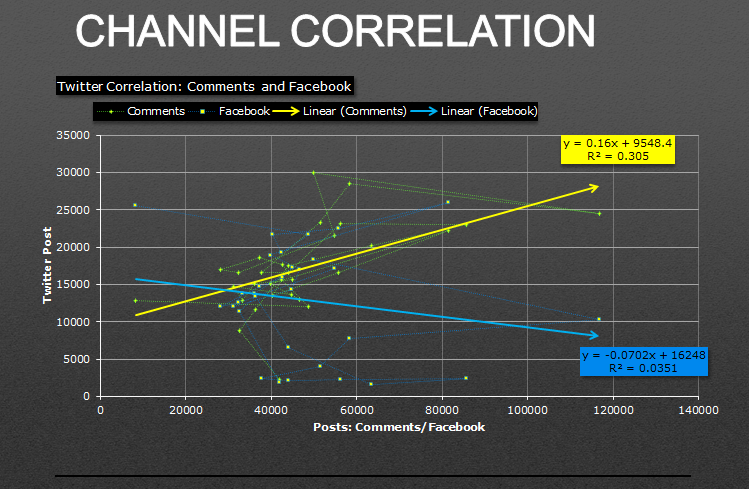
The Chart shows the correlation of Media comments and Facebook posts, in reaction to Twitter output , in regards to GOP primary Candidates. It’s no surprise there is a downward trend for Facebook. The two channels tend to be segregated politically. Twitter being more conservative and Facebook being more liberal.

European Parliament Leadership: Channel Marketshare


While it’s trendy for public affairs professionals talk about social media, Twitter and Blogs, it’s naïve to think these are the main channels for engagement when it come to European Parliament Party leadership. Online mainstream news simply dominates in comparison.  It sets the tone of the issue, gets the most comments, and is shared ,“Liked” and Voted on the most.

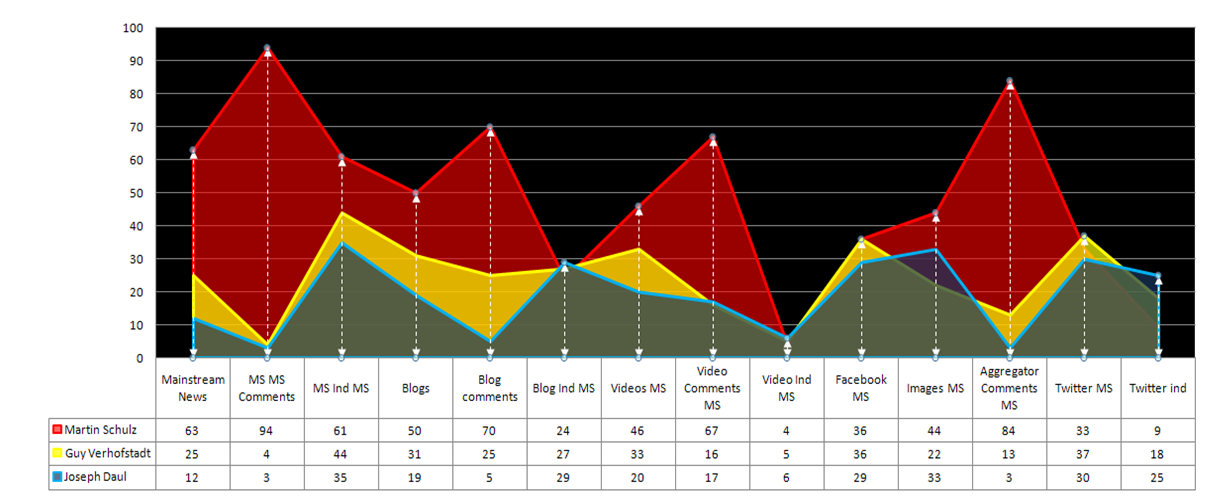
Diving back into market shares and what leader controls each medium. The chart above shows  just how dominate Martin Schulz (at the time leader of the S&D at the European Parliament. Schulz has now replaced Jerzey Buzek as it’s President) was in December. MS controlled just about every medium, as well as has the most comments.

Starting from the right we see Mainstream News percentages and how each leader stacks up:

  • Martin Schulz (MS)  63%,
  • Guy Verhofstadt (GV) 25%
  • Joseph Daul (JD) 12%

On the second box from the left “MS ind MS” shows the market share of the medium/channel, in this case mainstream, is being use by the Party Leader. Mainstream news made up 61% of Martin Schulz’s online media. Comparatively GV is at 44% and JD is 35%. In all cases main stream on-line news provides the most media and comments for all leaders. Over the past six months I’ve seen a rise in Twitter, which is by far the most equal platform, and also JD’s 2nd highest individual medium.

We can conclude two things from the prior chart:

  • MS is winning the online battle for media and engagement. He owns 94% of comments leaving only 4% to GV, and 3% to JD.
  • JD severely under performs given the EPP’s size and amount of money they have.