Unfortunately the high cost of doing business – taxes, labour laws and questionable professional standards across all member states, threatens to marginalizes the EU between Asia and the US.
USA= Innovation, quick to adapt, dynamic work force, large integrated market.
Asia = Cheap labour, willingness to adapt, on the up and up.
The main issue is hesitation to adopt any new methods. In a knowledge economy such as the EU, liquidity of knowledge is a huge asset. None the less, as we see from the data debate, there are only worries and fears, no positives. This is partly Google and Facebook’s fault for not controlling the debate better, although with the cultural differences, I’m not sure it matters.
What ever side of the debate you are on, there is no way the Commission/Parliament will be able to regulate at the speed that such companies innovate and develop new technologies.
I liken it to a scenario:
Jose is trying to learn how to get a date. He decided to go to a conference at a hotel that explains how to do this. On his way to the room where the conference was being held, Jose encounters two doors. One leads to the conference on how to pick up a date. The other door has a sign that says “Successful single women’s conference. Please join us for a drink. Anyone is welcome”. Jose chooses the first door as he had planned, and continued learning and taking notes about how to get a date. The EU relationship with Technology is a lot like Jose’s approach to picking up a date, hesitant and unwilling to adapt in real-time, to the peril of the end goal.
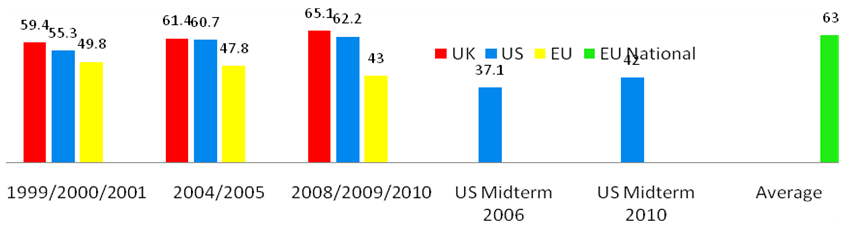
In October I was giving a presentation about on-line media, trend, and sentiment analysis/monitoring to institution officials. During the presentation I was asked “why do we need to understand what people are saying about us?” Admittedly I was a bit shocked. Interest in the EU has gone down every year since 2004 http://ow.ly/8w2Gs, as well as voting rates. In my view a good place to start building a proper message that mobilizes people, is to find out how people perceive and talk about you in the first place. Thinking about the institution officials statement further, I concluded the real issue wasn’t that that online monitoring couldn’t be useful for their goals, but it would have created a real-time approach, the antithesis of the institutional process Europe is familiar with. The incentive wasn’t there either.
In the globalized future hesitation is dead, improvisation is king, and competition will be fierce. Both EU firms and institutions spend too much time discussing what technologies such as social media mean or can do but never act. On the opposite, competition is the USA led to elections becoming a science. The 2012 campaigns will feature natural language processing, text mining, sentiment analysis, and data scientists. These technologies will marginalize every medium and word. There will be no room for “educated guessing”. This is efficient and saves time and money. Further it may help yield larger voter turnout as did the 2008 U.S. elections. Forward to the EU. The system is not competitive. The money is provided by the public, and the European Commission is in charge of getting people to vote with a neutral message. And they are still having conferences about what social media means.The future will embrace adaptability and change, you don’t get the luxury of writing a 10,000 word strategy paper, or a controlled institutional process, life and business move too fast. If the EU is going to have a chance using technology to it’s full advantage , it must first take a shot, and ask it out on a date.



 Machine Lens
