Sentiment Analysis: Why is it important?

WHY IS ONLINE MEDIA IMPORTANT TO LOOK AT?

I examine this question with the help of Charts and the EU. Thank you..Click on the Charts to make them bigger.

So why is looking at on-line media important? The chart above (Lau, 2001) shows online media has expanded in the last 16 years. Online news has displaced print and broadcast to represent 46 percent of all content monitored globally. Increasingly online communications/media is becoming the main source of people’s knowledge for political affairs. In the era of the mediatization in politics and democratic theory, which assumes that an informed and attentive public is necessary for democracy to work effectively (Lau, 2001), understanding on-line communications is vital.

The Analysis of on-line media is a cross between what’s called data science[1] and “Culturomics” (Leetaru, September 2011). The goal is to find cultural trends through computerized analysis of online media to develop insights in the functioning of human society, thoughts and actions (Michel, et al., 2011). This process has been very accurate in forecasting instances such as box office sales (Mishne and Glance, 2006) to the stock market (Bollen, et al., 2011). To illustrate the power of data science and sentiment analysis in a political context scientist – using a super computer, applied tone and geographic analysis to a 30 year worldwide news archive. The scientist were able to forecast the revolutions in Tunisia, Egypt, and Libya, the removal of Egyptian President Mubarak, the stability of Saudi Arabia, and estimated Osama Bin Laden’s hiding place within a 200–kilometer radius, in Northern Pakistan.

The point of all of this?

Media is a very accurate source for insights into the human condition, as well as our thought process. Now with the rapid expansion of online media, there is a wealth of untapped knowledge and syntax to further analyse.

EXAMPLE:
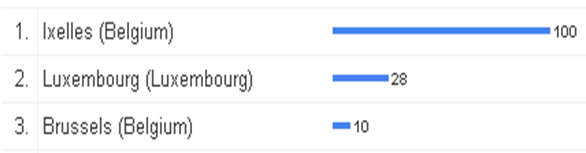
The chart above shows the volume of searches based on the terms “European Parliament”, “European Commission” and “European Union”. They were also translated into French, German and Italian for further accuracy. The data was gathered with Google Insights[1] for Search. The chart does not track positive or negative sentiment, just the volume of the terms searched through Google[2]. The data clearly shows the interest in the EU has gone down since 2004. For both the European Parliament and Commission the top locations for the searches of the term were Ixelles, Luxembourg and Brussels – all home to the institutions themselves. This illustrates the “Brussels Bubble” that so many talk about
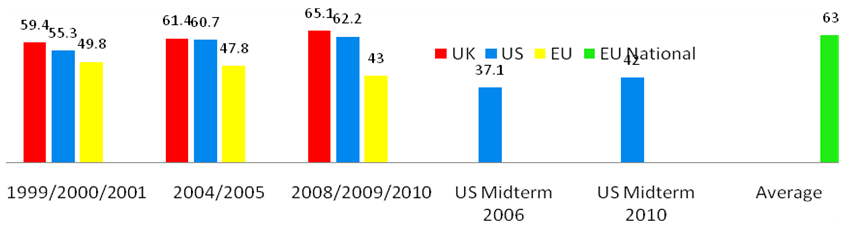
The Google insights data mirrors voting rates. In other words, voting rates (above) and participation have gone down.
The variables:
  • Lack of a unified media, hesitation on real-time engagement, failure to leverage modern instruments and an incentive to do so.
  • MEP and political parties do not have to raise money for re-election, and there is little incentive to actively engage constituents, on an individual MEP level as well since the parties puts forth the Politicians.
This frame work has lead to autonomy and citizens that look more toward national politics for answers. With the current financial “Euro” crisis it would be easy to assume that the interest in the EU – whether good or bad, would go up. This has not happened.

[1] With Google Insights for Search, you can compare search volume patterns across specific regions, categories, time frames and properties. See examples of how you can use Google Insights for Search.

[2] Google’s search market share in Europe is around 90%. In the U.S. it’s around 65%.


[1] The profession of interpreting and creating value from Data.

EU Political On-line Trend Graph From the 2011 Summer

I thought that I would post a trend chart that I found. It is from the 2011 summer of rebellion. Please ask questions:


Heuristics, Algorithms and Communications: Quick Thoughts

The use of heuristic and taxonomy algorithms for identifying cognitive bias in  communications is a game changer.  According to SAS,  companies that invest in analytics out perform the S&P500 by 64%. I imagine the margin for communication/marketing firms is greater. The market is not anywhere close to mature, and is lopsided to a few in the know. The rest toil in mediocracy via old connections/business that will surely run ground soon.
Today’s great business’s – for the most part, are data driven. Communications is perceived  to be educated guessing.. The use of programming for bias is important because bias cannot be out run. Think of this much like “Inception” and Moneyball combined.

Thanks to social networks we have the largest focus group in history. Analysts can see what people are using to explain how they feel and think – during  specific situations or events. This can also tell  how people interact within context of syntax or an instances. Very powerful and cheap information in contrast to polling or focus groups.

There are patterns/norms with how people engage on each medium. In addition to what type of syntax they use to convey a certain type of  thought. This is all programmed in the mind for the most part. Linguist like Lakoff and Chomsky suggest that brains are hard wired to favor certain patterns that convey meaning. This plays out accurately on-line consistently.

Just a random Sunday thought…Now looking forward to watching the NFL playoffs.

Ciao

Market Shares and Topic Correlations: European Parliament Party Leadership

The chart above shows how much associated EP Group  leaders have on a variety of EU topics market share of the leaders on different subjects, including their own party. It’s possible that all leaders can be in more than one article so the totals can be over 100%.  The Green line rank the subjects of all the leaders combined. The EU ranks 1st followed by the Parliament – which should be expected, and then the Euro. Joseph Daul (JD) has the most association for the EPP Group at 81%, which is a good indicator for further party branding but not for pan EU leadership , where he lags behind all others.

On the far right, the chart shows the average and over/under performance to the market share compared to Group Parliament seats.

  • Guy Verhoftstadt (GV) (ALDE) is +7,
  • Martin Schulz (MS) (S&D) is + 20
  • Joseph Daul  (EPP) is at -20.

This does not fare well for the EPP Group. When looking at the market shares of EP leaders in context to one another, JD is consistently in last place. Why does the EPP vastly underperform while the S&D and ALDE over perform? This can be due to a number of reasons.

  • JD does not speak English
  • The EPP being the largest group cannot utilize polarizing and thus mobilizing language without alienating many of their MEP’s.
  •  JD has chosen to stay out of the spotlight given that Jose Barroso and Herman Van Rompuy[1] are EPP.
  • MS is from Germany which is heavily discussed at the moment, and will also become the new President of the European Parliament replacing Jerzey Buzek[2].

Robert Fitzhenery (Head of EPP Group Press and who controls the communications and outreach budget) explained to me that the EPP Group cannot be too polarizing on political issues because of it’s size, and cannot risk alienating some MEPs. On the other end some in the Group want to be more polarizing to mobilize debate and heighten the Groups profile.

During my work with the EPP, ALDE and GV typically lead market shares on media despite only having an 11% (88 of 754 MEP seats) market share of the Parliament[3]. I talked with Neil Corlett, Head of Press and Communication for ALDE. Neil explained since ALDE was a smaller group, they decided to follow whatever GV wanted and not deviate from a few main points. In short their message is consistent via both GV and ALDE’s MEPs. It paid off. ALDE is outperforming the EPP and S&D. And both have more money. It’s only in the last two months that MS has been generating so much sentiment. It will be interesting to see if this approach pays off in the 2014 EP elections. It will also be a good indicator of how mature the on-line EU landscape is.

Communications as Productivity

By looking at Communications in terms of production and variables, you will save millions. By not understanding variables in communications, you will loose millions and time. Gone where communication firms can pass  Bullshit. Now it’s far from an art form with metrics. Clients should expect decision making based on sound research, in addition to  web analytics and online monitoring data.

The goal: Create the most productive syntax, which could be words, photos,video or interactive digital content. Not the most view and clicks

Resonance: 

Output time/date to channel dissemination, and how much time  that takes. It shows language adoption, which is how you win. There’s a saying politics, “Win the language battle, win the war”.  Resonance is a good KPI for knowing if the framing has retention, thus productivity.

Its can also be useful to reverse engineer a past event’s content and framing with machine learning to compare and contrast. Again don’t focus too much on “click and looks”. You might see exponential gain which perhaps are linked to offline events. That way you can also map correlation. I tend to see this pattern a lot working in politics. This reiterates the massive amount of information available on-line by listening.

More Tricks:

Use best practices in cognitive ICT, psychology,linguistics and behavior economics. A real expert will know captology, sentiment analysis and gamification, and not neglect fundamental and technical analysis.

When you understand the basic variables, you see that  each enhances or destroys productivity.

If the person you hired  doesn’t understand what I’m talking about, the strategy will loose productivity. Ask yourself, why we are paying 200-300 plus per hour? Educated guessing is over. The data doesn’t lie.

Abandon Your Communication Strategy

You or your organization is not special to the news cycle. It’s goal should be smarter, faster, cheaper. While it might not seem like it, faster -despite large investment coast, are 90% of the time cheaper. They save on opportunity loss/cost.

Many organizations and political groups write a long, dull strategy for their communications. The idea is out dated.  Today’s modern communication environment is fast. It’s real-time, and it doesn’t care about you. It’s not an option to rely on un-adaptable 10,000 word papers if the goal is to stay relevant.

Don’t worry.

If you are good at data science and have monitoring tools, you’ll mitigate risk.  Build a COMM infrastructure that can handle “real-time”. The main things is to trust in the Data (it doesn’t lie), and remember  the strategic advantage of real-time outweighs the majority of mistakes you could  make.