German EPP MEP Disconnect

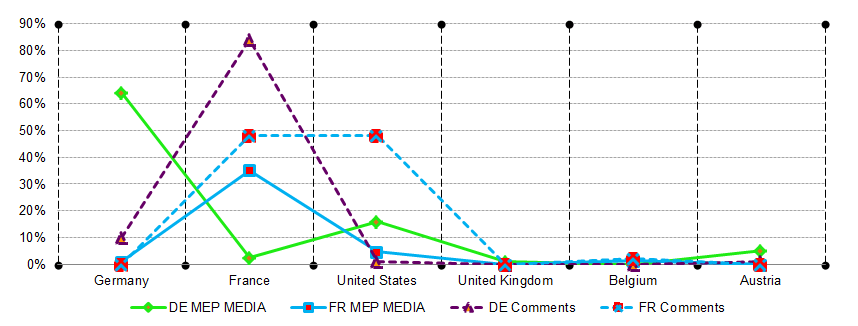
Regional online media engagement  for  German and French EPP MEP’s:  The chart clearly illustrates Germany is not engaged with their European Parliament representation, or better, the MEPs are clearly not in touch with their constituents. Can someone say democratic deficit?

•64% of German EPP MEP media is coming from Germany.
•84% of commented media on German MEP’s is from France.
•Germany only accounts for only 10% of comments of  it’s MEPs.
•Germany  does not comment on  French EPP MEPs (0%).
•French EPP MEP comments are from the USA and France (both 48%) and Belgium at 2%.

Analytics and the Global Political Environment

In the global political environment a holistic view is needed.

The standard for message delivery is high in the modern media environments. It’s vital to create communications that people identify and empathize with. The threshold to get attention, and to get people to retain your information, is even higher. Politics now competes with Pepsi, Nike and Apple. No one will take time to care about your views or propositions. Firms must be proactive in both controlling and framing language, as well as marginalizing their communication and political strategy for efficiency.

The problem: There are many variables to consider when developing productive communication and political strategies. Further, basing decisions on just educated guessing, even for the most highly skilled and experienced  professional, does not meet the standards of modern business practices, which use analytics to make decisions.

The Solution: Online media provides an immense amount of information which can be monitored. The data can be used  to track political and policy instances qualitatively, as well as forecast.

To do this, we must synthesize research in cognitive linguistics and Natural Language Processing (NLP). In the last few years these technologies have evolved to the point where pragmatics can be quantified accurately. And further, because of the amount of data an average person creates in a day, we have and endless amount of information to drill down into for examining political and cultural phenomenon.

I’m currently looking at the French elections. There will be more on that and this in a bit.
Twitter and it’s Correlation to Facebook and Media Comments: GOP Primaries

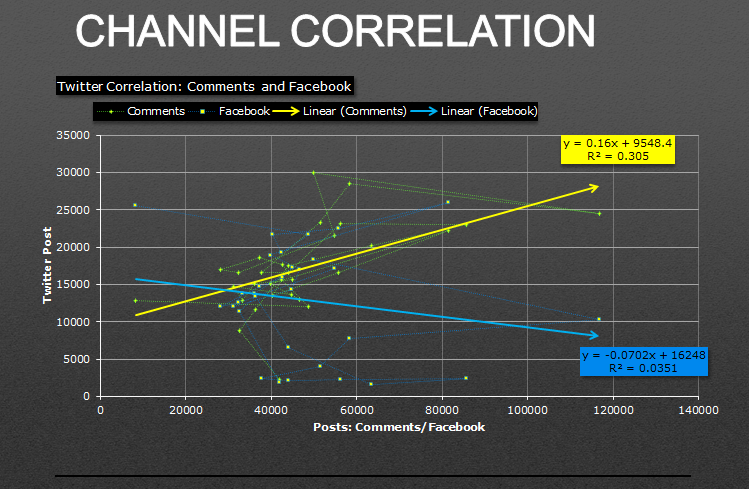
The Chart shows the correlation of Media comments and Facebook posts, in reaction to Twitter output , in regards to GOP primary Candidates. It’s no surprise there is a downward trend for Facebook. The two channels tend to be segregated politically. Twitter being more conservative and Facebook being more liberal.

War Themes: News Output and Search Interest

Recently, I was doing a project to see if there was a correlation of war themed News and the Search interest. I found that there was indeed. .86 for Iraq and a .46 correlation for the strategically framed “War on Terror” language. I guess Chomsky and Lakoff are/were right. These findings are also in line with a study in 2010 by Daniela V. Dimitrova and Jesper Strömbäck. Their research concluded that U.S. Elite newspapers had higher patterns of  military conflict framing, and  used more official government and military sources. In contrast, Elite Swedish newspapers displayed more “responsibility and anti-war protest framing”, and were more critical of the war.

U.S. Political Elections

Political Trends 

I’m very surprised Santorum, though unelectable to the general population, is still in the race still. Although the more Romney talks, the harder it is to watch. It’s almost like he hires too many “Yes Men”. He needs a campaign manager that will slap him when he goes on a rant about trees in Michigan. Who says that kind of stuff? I predict this now; Obama wins..

Pragmatics

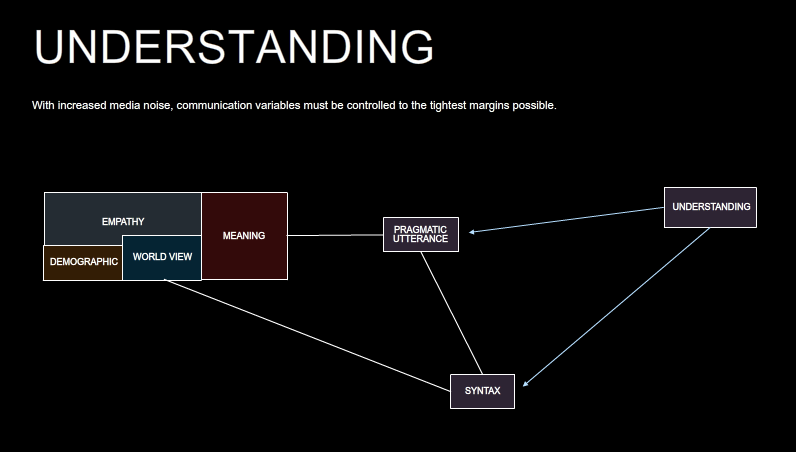
I’m interested in the pragmatics. The utterance on the medium, not the mediums themselves. And then the understanding of the utterance, from a cognitive perspective.

Why?

This is the key. Media, rhetoric and influence doesn’t go beyond pragmatics. Until the days when we hook our selves up to a computer, and that day will come, we have to rely on understanding the interaction between syntax and utterance, with in a multi-variable context. Variables could include Channel – Facebook, LinkedIn, New Papers, Tablets,PC, Mobile. Each has a specific type of interaction and legitimacy structure. Once adopted, a Frame is pushed  and the culture crated. By looking at the interaction between Man and machine, we get valuable information.  This is researched with in the study of Captology from the Stanford lab. It’s headed by B.J. Fogg. Very interesting stuff.

More a bit later. I need a cafe, you can loose yourself in the logic surrounding this type of thinking.

Ciao CT

European Parliament Leadership: Channel Marketshare


While it’s trendy for public affairs professionals talk about social media, Twitter and Blogs, it’s naïve to think these are the main channels for engagement when it come to European Parliament Party leadership. Online mainstream news simply dominates in comparison.  It sets the tone of the issue, gets the most comments, and is shared ,“Liked” and Voted on the most.

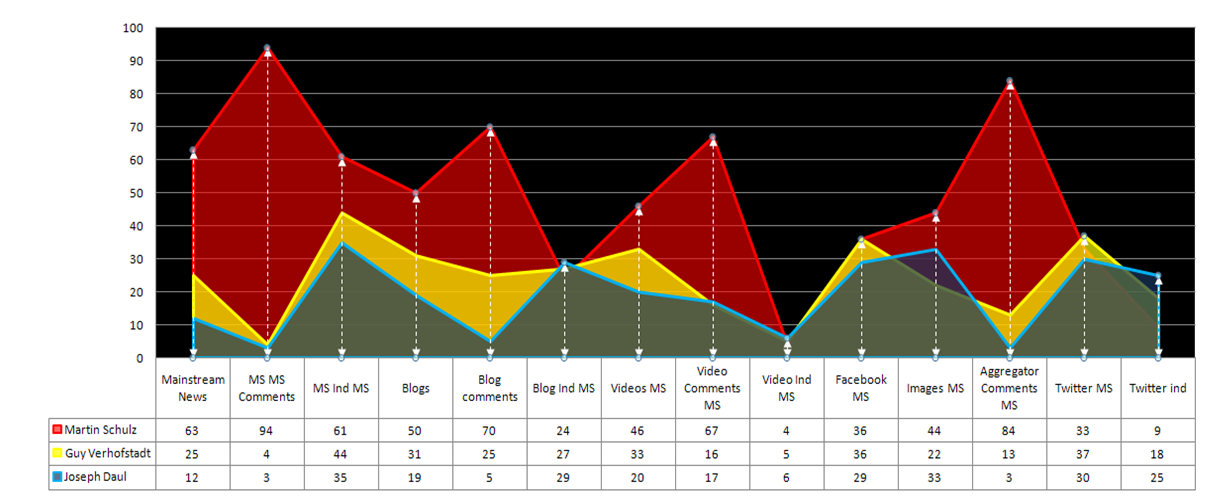
Diving back into market shares and what leader controls each medium. The chart above shows  just how dominate Martin Schulz (at the time leader of the S&D at the European Parliament. Schulz has now replaced Jerzey Buzek as it’s President) was in December. MS controlled just about every medium, as well as has the most comments.

Starting from the right we see Mainstream News percentages and how each leader stacks up:

  • Martin Schulz (MS)  63%,
  • Guy Verhofstadt (GV) 25%
  • Joseph Daul (JD) 12%

On the second box from the left “MS ind MS” shows the market share of the medium/channel, in this case mainstream, is being use by the Party Leader. Mainstream news made up 61% of Martin Schulz’s online media. Comparatively GV is at 44% and JD is 35%. In all cases main stream on-line news provides the most media and comments for all leaders. Over the past six months I’ve seen a rise in Twitter, which is by far the most equal platform, and also JD’s 2nd highest individual medium.

We can conclude two things from the prior chart:

  • MS is winning the online battle for media and engagement. He owns 94% of comments leaving only 4% to GV, and 3% to JD.
  • JD severely under performs given the EPP’s size and amount of money they have.

Active Communications

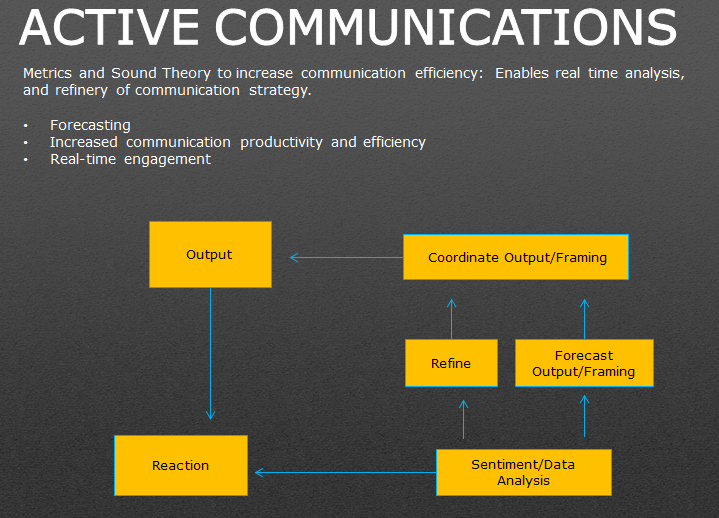
The idea of “Active Communications”  is based heavily on media monitoring listening data AND proper framing, which is a bit of an art (unless you have first class AI/NPL skills) . To work efficiently, a multi-channel infrastructure that allows for real-time content is paramount.

Important concepts to take away:

  • Timing and message coherency, to create a critical mass.
  • Trust the data for real time decision making.
  • Location based targeting with Fundamental,Technical and Sentiment analysis, per channel/medium.

Perhaps the biggest aspect is willingness to abandon prior methods after the data is received. You might be more comfortable with Twitter or another channel, but for the specific campaign it could be a  waste of time. Don’t fight up stream.

NLP: Value Greater than just Positive and Negative Sentiment.

Positive (P) and negative (N) sentiment are just transmitting two results based on many other variables. This in itself contains little knowledge. For creating strategy, it can only bench mark after the fact.

Inherently the use of data is to make better decisions for the future. Production is expensive and time consuming. So is deductive reasoning.  The main goals should be to move away from adjusting to the end reaction and migrate to a predictive model. Look at the context in higher resolution i.e. control for  variables which lead to PN sentiment.

Here are some suggestions

  • Time of day
  • Medium (Twitter,Facebook ,Blogs, Mainstream news)
  • Comments PN sentiment
  • New dissemination to comment count (time, PN)

If you are advanced, use NLP tools that allow for custom taxonomies – within the NLP,  to create rules on varibels like types of framing. On a medium level this is very good at prediction, but more on that later.

Ciao