Category: Corporate Culture
Things to consider when driving machine intelligence within a large organization
While modern day A.I. or machine intelligence (MI) hype revolves around big ”eureka” moments and broad scale “disruption”, expecting these events to occur regularly is unrealistic. The reality is that working with AI’s on simple routine tasks will drive better decision making systemically as people become comfortable with the questions and strategies that are now possible. And hopefully, it will also build the foundation for more of those eureka(!) moments. Regardless, technological instruments allow workers to process information at a faster rate while increasing the precision of understanding. Enabling more complex and accurate strategies. In short, it’s s now possible to do in hours what it once took weeks to do. Below are a few things I’ve found helpful to think about when driving machine intelligence at a large organization, as well as what is possible.
- Algorithm Aversion — humans are more willing to accept the flawed human judgment. However, people are very judgmental if a machine makes a mistake – even within the lowest margin or error. Decisions generated by simple algorithms are often more accurate than those made by experts, even when the experts have access to more information than the formulas use. For further elaboration on making better predictions, the book Superforecasting is a must read.
- Silos! The value of keeping your data/information a secret as a competitive edge does not outrun the value of potential innovation or insights if data is liberated within the broader organization. If this is possible build what I call diplomatic back channels where teams or analysts can sure data with each other.
- Build a culture of capacity. Managers are willing to spend 42 percent more on the outside competitor’s ideas. Leigh Thompson, a professor of management and organizations at the Kellogg School says. “We bring in outside people to tell us something that we already know,” because it paradoxically means all the wannabe “winners” in the team can avoid losing face”. It’s not a bad thing to seek external help, but if this is how most of your novel work is getting done and where you go to get your ideas you have systemic problems. As a residual, the organization will fail to build strategic and technological muscle. Which is likely to create a culture which emphasizes generalists, not novel technical thinkers in leadership roles. In turn, you end up with an environment where technology is appropriated at legacy processes & thinking – not the other way around (if you want to stay relevant). Avoid the temptation to outsource everything because nothing seems to be going anywhere right away. That 100-page power point deck from your consultant is only going to help in the most superficial of ways if you don’t have the infrastructure to drive the suggested outputs.
OSINT One. Experts Zero.
Our traditional institutions, leaders, and experts have shown to be incapable of understanding and accounting for the multidimensionality and connectivity of systems and events. The rise of the far-right parties in Europe. The disillusionment of European Parliament elections as evidenced by voter turnout in 2009 and 2014 (despite spending more money than ever), Brexit, and now the election of Donald Trump as president of the United States of America. In short, there is little reason to trust experts without multiple data streams to contextualize and back up their hypotheses.
How could experts get it wrong? Frankly, it’s time to shift out of the conventional ways to make sense of events in the political, market, and business domains. The first variable is reimagining information from a cognitive linguistic standpoint. Probably the most neglected area in business and politics – at least within the mainstream. The basic idea? Words have meaning. Meaning generates beliefs. Beliefs create outcomes, which in turn can be quantified. The explosion of mass media, followed by identity-driven media, social media, and alternative media, is a problem, and we are at the mercy of media systems that frame our reality. If you doubt this, reference the charts below. Google Trends is deadly accurate in illustrating what is on people’s minds the most, bad or good, wins – at least when it comes to U.S. presidential elections. The saying goes bad press is good press is quantified here, as is George Lakoff’s thinking on framing and repetition (Google search trends can be used to easily see which frame is winning, BTW ).


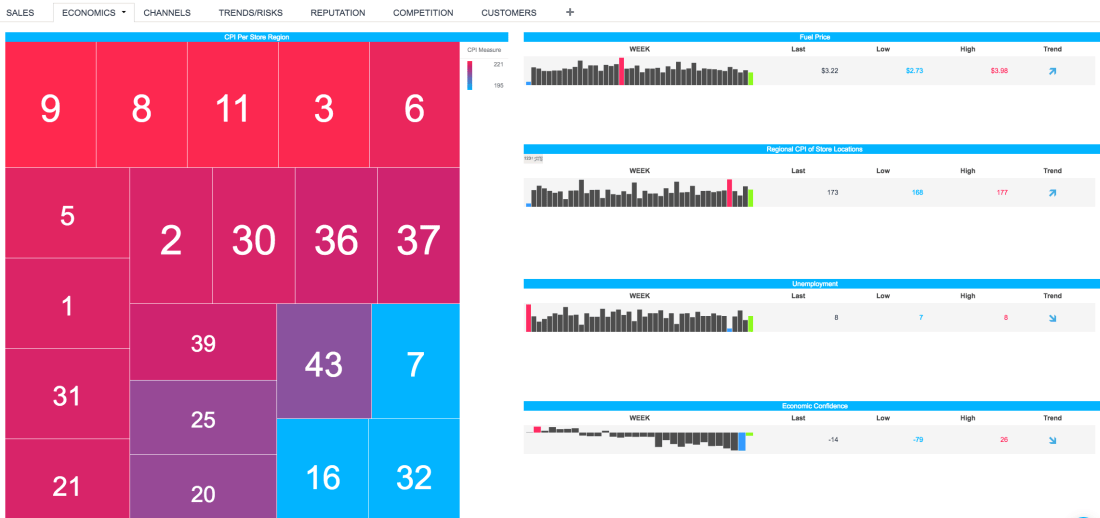
Within this system, there is little reason to challenge one’s beliefs, and almost nothing forces anyone to question their own. Institutions and old media systems used to be able to bottleneck this; they were the only ones with a soapbox, and information was reasonably slow enough. There is a need for unorthodox data, such as open-source intelligence (OSINT) and creativity, which traditional systems of measurement and strategy lack to outthink current information systems. To a fault, businesses, markets, and people strive for simple, linear, and binary solutions or answers. Unfortunately, complex systems, i.e., the world we live in, don’t dashboard into nice simple charts like the one below. The root causes of issues are ignored, untested, and contextualized, which creates only a superficial understanding of what affects business initiatives.


I know this may feel like a reach in terms of how all that is mentioned is connected, so more on OSINT, data, framing, information, outcomes, and markets to come.
Cheers, Chandler
The Brexit
While investors were in shock, open source signals such as Google trends often pointed to “Leave” predominating, illustrating expert and market biases. Perhaps they should work on integrating these unconventional data streams better (sorry couldn’t help it). The UK’s decision to exit from the EU is part of a larger global phenomenon that could have been understood better with open source, not just market, data.

The world is growing more complex. Information is moving faster. Humans have not evolved to retain or understand this mass output of (dis) information in any logical way. As a response, a retreat to simple explanations and self-censorship towards new ideas that might challenge one’s frame are ignored and become the norm. Populist decisions are made and embraced, oftentimes reactionary towards the establishment or elite. Multi-national corporations and elites will need to step outside of their bubble and take note of nationalist, albeit sometimes isolationist, such as Donald Trump, Bernie Sanders, President Erdogan of Turkey, Marie Le Pen’s Front National of France, Boris Johnson – Former Mayor of London and Brexit backer (good chance he takes David Cameron’s place), Germany’s AFD and the 5-star movement in Italy gain in both popularity and power.


In addition to the more media coverage, more people were associated with the leave campaign, which is an advantage. During a political campaign, choices and policy lines are anything but logical; they tend to fall on emotional lines, so institutional communications must have a noticeable figurehead, especially in the media age. It says something when the top people who are associated with Remain are Barak Obama, Janet Yellen, and Christine Lagarde. Note that David Cameron is more central with leave. Nonetheless, the pleas by political outsiders and institutions such as the IMF and World Bank for the UK to remain in the EU potentially caused damage to the “Remain” campaign. UK voters did not want to hear from foreign political elites. This is illustrated by the connection and proximity of the “Obama Red Cluster” to the French right-wing Forest Green cluster (and the results) below. The “Brexit” could lend credence to the possibility of EU exit contagion. There are very real forces in France (led by the Front National) and Italy (led by the 5 Star Movement (who just won big in elections) that are driving hard for succession from the EU and or, potentially, the Eurozone.

Ramifications:
- Banks (especially European ones) are fleeing to the gold market, seeking shelter from volatility. While this is to be expected, dividend-based stocks and oil would also be attractive to those seeking stability.
- Thursday’s referendum sent global markets into turmoil. The pound plunged by a record, and the euro slid by the most since it was introduced in 1999. Historically, the British Pound reached an all-time high of 2.86 in December of 1957 and a record low of 1.05 in February of 1985.
- Don’t count on US interest rate hikes. Yellen has expressed concern about global volatility on multiple occasions. The Brexit just added to that. The Bank of England could follow the US Fed and drop interest rates on the GBP to account for market uncertainty.
- If aggressive, European uncertainty could allow US companies to gain on European competitors. Due to the somber mood within Europe, companies could be more conservative with investment, leaving them vulnerable.
- Alternatively, Brexit may trigger more aggressive U.S. or global expansion by European Companies while the ramifications of Brexit are further understood.
- The political takeaway is that the Remain campaign was relatively sterile, with no figurehead or clear policy issues directly related to the EU. This was reflected by the diversity in associated search terms related to the “Leave” campaign. In addition, Angela Merkel, not an EU leader such as European Commission President Jean-Claude Junker, was once again seen as the de facto voice of Europe.
Next Generation Metrics
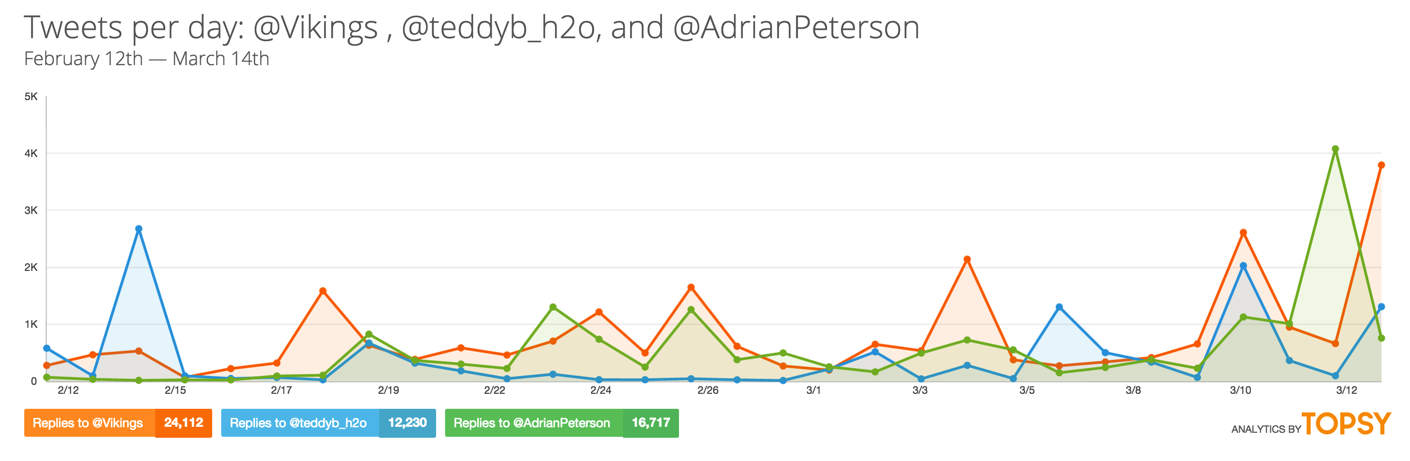
Recently I’ve been thinking of ways to detect bias as well as look into what makes people share. Yes understanding dynamics and trends over time, like the chart below (Topsy is a great simple, free easy tool to get basic Twitter trends), can be helpful – especially with linear forecasting. None the less they reach their limits when we want to look for deeper meaning – say at the cognitive or “information flow” level.
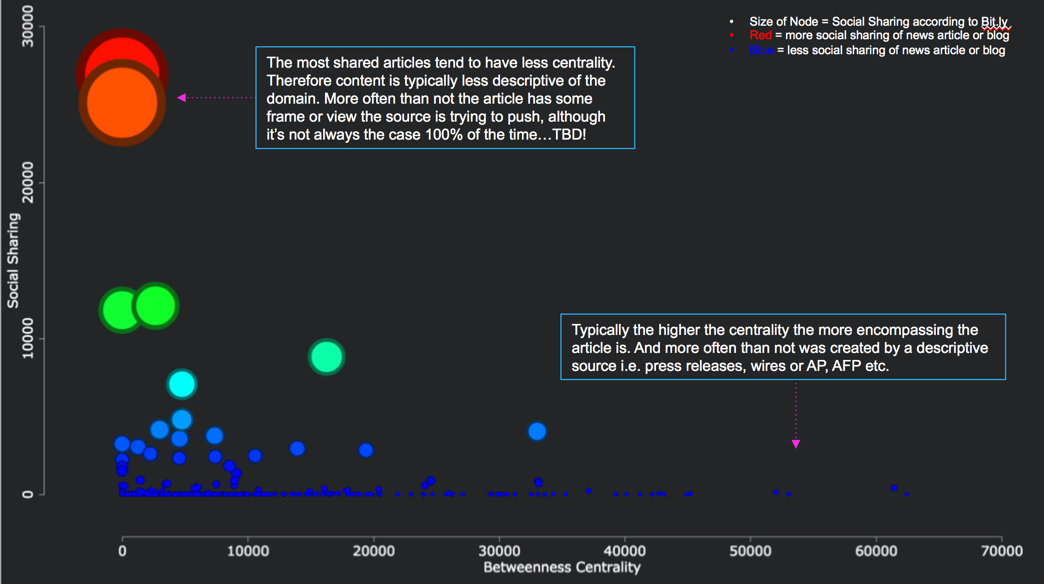
Enter networks. This enables an understanding of how things connect to and exist at a level that is not possible to do with standard KPIs like volume, publish count and sentiment over time. Through mapping out the network based on entities, extracted locations, and similar text and language characteristics it’s possible to map coordinates of how a headline, entities or article exists and connects to other entities within the specific domain. In turn, this creates an analog of the physical world with stunning accuracy – since more information is reported online every day. For example, using to online news articles and Bit.ly link data, I found articles with less centrality (based on the linguistic similarity of the aggregated on-topic news article) to their domain, which denote variables being left out (of the article), typically got shared the most on social channels. In short, articles that were narrower in focus, and therefore less representative of the broader domain, tended to be shared… This is just the tip of the iceberg.
The EU: Hooking up with Technology
Jose is trying to learn how to get a date . There’s a conference at a local hotel on how to pick up women. On his way to the room, Jose’ encounters two doors. One leads to the conference taught by men on how to pick up girls. The other door has a sign that says “Successful single women’s conference. Please join us for a drink, anyone is welcome”. Jose chooses the first door as he had planned, and continues learning about how to pick up women. The EU relationship with using technology is like Jose’s approach to trying to pick up women, hesitation and unwillingness to adapt in real-time, to the peril of the end goal – i.e. institutional.
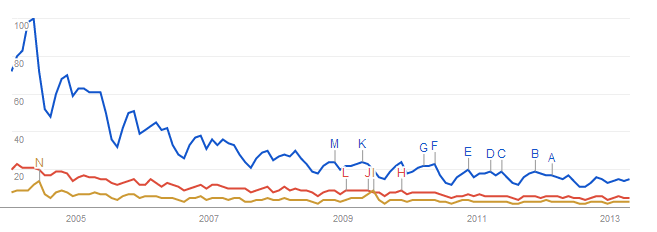
One day I was talking about online media monitoring to the institutions “social media expert”. I was asked “why do we need to understand what people are saying about us?” I was shocked and had no answer except to point out Interest in the EU has gone down every year since 2004 http://ow.ly/8w2Gs. Specifically alarming was that the Parliament, which is supposed to be the extension of the people, had the lowest interest rate.

Red – European Commission
Yellow – European Parliament
Now having worked in US politics, a good place to start making a more legitimate government, is being more representative of constituents..and understanding what people are saying about you allows you to create better policies and messages that can help engage people, and perhaps increase the voting rates.
Both EU firms and institutions spend way too much time discussing what technology such as social media is, or what it means, but never act. For example Friends of Europe just released a paper about social media . Frankly I found it pointless, uninteresting, and six years too late.
In the globalized future hesitation is dead, improvisation is king, and competition will be fierce…
Thinking about the “social media experts” statement further, I concluded it wasn’t that online monitoring wasn’t useful for their situation, but it’s use would have created a real-time approach. This is the antithesis of institutional process Europe is way too familiar and comfortable with. And incentive for the people working in the institutions wasn’t there either.
In the USA, competition has led to campaigns and politics becoming a science. And voting rates + political involvement have gone up.
The 2012 campaigns featured natural language processing, text mining, sentiment analysis, and data scientists. These technologies will marginalize every medium and word. There was no room for “educated guessing”. This is efficient, saves time and money, plus leaves the politicians to focus on empathizing more with the electorate. Forward to the EU. The system is not competitive. The money is provided by the public, and the European Commission is in charge of mobilizing people in a non-political way, which is inherently very, very difficult.
The future will embrace non-understanding, chaos and real-time data, you don’t get the luxury of writing a 10,000 word strategy paper. At present the EU mindset is not equipped to handle this transition. It must remember if it wants to hang out with future technology, it has to first quit talking, and ask it out on a date.
Ciao, CT
Making “Corporate Culture” without the parentheses.
Much of this post was taken from a comment I wrote on LinkedIn in which I talked about vision and corporate culture (http://goo.gl/UIwUv). While a lot has been said of “corporate culture”, most of the time this is under the guise of CSR reforms and other similar bullshit jargon. Being a data man who relies on sound principles, I fully agree that an internal focus from leadership is essential. For change that “takes” there needs to be an internal process and protocol set that reinforces the change in addition to clear incentives and goals. In other words, make it so you can’t get out of it. It’s also important to remember that setting out and visualizing a corporate culture is often times different than building a sustainable and profitable culture that makes bleeding edge solutions and products that people and companies want to buy.
What I find painfully obvious, and a huge risk to building a sustainable corporate culture that breeds future relevance, is that lack of perspective and group thinking tend to build off one another. These are the banes of any culture seeking to be relevant and innovative in the highly competitive, interconnected, but often times different enough world.
Think about this: The majority of leaders and directors come from the same schools, have the same frame of mind and generally have had an upward linear career path that was safe. They went to the best schools, got good grades and were very smart. While intelligence and capability are no doubt quality prerequisites and parts of the solution, companies will inherently lack “grit” and suffer opportunity loss for the intellectual capital gained from it (Good article on grit http://goo.gl/W8Dxj) . Ultimately, the perspective that is essential for good decision making is affected (McKinsey; Kahneman and Klein article on this http://goo.gl/0bFcC). I find grit and perspective to be the main bottle necks in building a company culture that embraces disruption and leverages it fast, the holy grail of most of this research. So with that I challenge leaders to step up and get real with developing “corporate culture” legitimately (diverse/non group think environment) so it isn’t in parentheses as it often is.
Bring in fuck-ups so you don’t fuck up. People you might not be comfortable with and you don’t get right away. They might not have gone to the right schools, and might be a bit crazy, but have succeeded in unique ways that make you question your job, skills and thinking. You might find you are not relevant. This is obviously scary to people, but it’s necessary to motivate them into learning new skills, in addition to creating a “check down” in the corporate process that maintains innovation and relevance.
Thoughts – SWOT away.. CT
Communications as Productivity
By looking at Communications in terms of production and variables, you will save millions. By not understanding variables in communications, you will loose millions and time. Gone where communication firms can pass Bullshit. Now it’s far from an art form with metrics. Clients should expect decision making based on sound research, in addition to web analytics and online monitoring data.
The goal: Create the most productive syntax, which could be words, photos,video or interactive digital content. Not the most view and clicks
Resonance:
Output time/date to channel dissemination, and how much time that takes. It shows language adoption, which is how you win. There’s a saying politics, “Win the language battle, win the war”. Resonance is a good KPI for knowing if the framing has retention, thus productivity.
Its can also be useful to reverse engineer a past event’s content and framing with machine learning to compare and contrast. Again don’t focus too much on “click and looks”. You might see exponential gain which perhaps are linked to offline events. That way you can also map correlation. I tend to see this pattern a lot working in politics. This reiterates the massive amount of information available on-line by listening.
More Tricks:
Use best practices in cognitive ICT, psychology,linguistics and behavior economics. A real expert will know captology, sentiment analysis and gamification, and not neglect fundamental and technical analysis.
When you understand the basic variables, you see that each enhances or destroys productivity.
If the person you hired doesn’t understand what I’m talking about, the strategy will loose productivity. Ask yourself, why we are paying 200-300 plus per hour? Educated guessing is over. The data doesn’t lie.