A Bit About Framing

Frames: The use of mental filters to make sense of incoming messages.  All views are Framed and are constructed through schemas that influenced how we  interpret the message. The goal of a communication professional is to create rhetoric  that consciously or unconsciously acts to construct a point of view, and make language more inclusive to constituents.
FRAMES OPERATE IN FOUR KEY WAYS:
  1. Identify Problems
  2. Diagnose Causes
  3. Make Moral Judgements
  4. Suggest Solutions
EXAMPLES:
  • You have a 75% chance of living
  • You have a 25% chance of dying
  • She is a cold person
  • She is a warm person
  • Estate Tax
  • Death Tax

Pragmatics

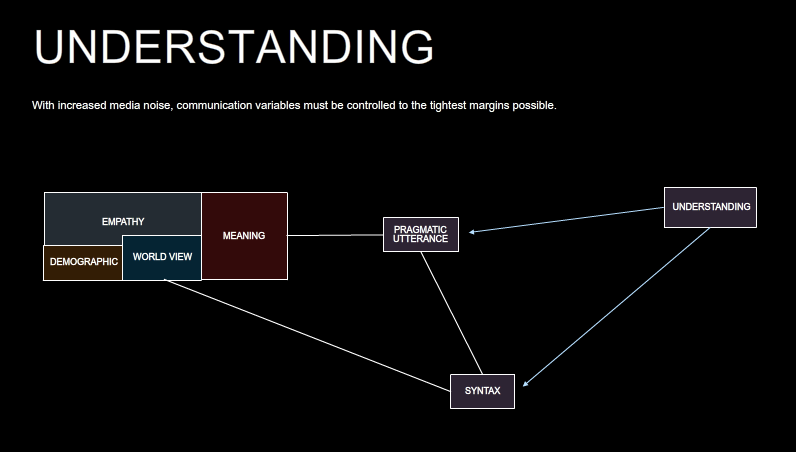
I’m interested in the pragmatics. The utterance on the medium, not the mediums themselves. And then the understanding of the utterance, from a cognitive perspective.

Why?

This is the key. Media, rhetoric and influence doesn’t go beyond pragmatics. Until the days when we hook our selves up to a computer, and that day will come, we have to rely on understanding the interaction between syntax and utterance, with in a multi-variable context. Variables could include Channel – Facebook, LinkedIn, New Papers, Tablets,PC, Mobile. Each has a specific type of interaction and legitimacy structure. Once adopted, a Frame is pushed  and the culture crated. By looking at the interaction between Man and machine, we get valuable information.  This is researched with in the study of Captology from the Stanford lab. It’s headed by B.J. Fogg. Very interesting stuff.

More a bit later. I need a cafe, you can loose yourself in the logic surrounding this type of thinking.

Ciao CT

European Parliament Leadership: Channel Marketshare


While it’s trendy for public affairs professionals talk about social media, Twitter and Blogs, it’s naïve to think these are the main channels for engagement when it come to European Parliament Party leadership. Online mainstream news simply dominates in comparison.  It sets the tone of the issue, gets the most comments, and is shared ,“Liked” and Voted on the most.

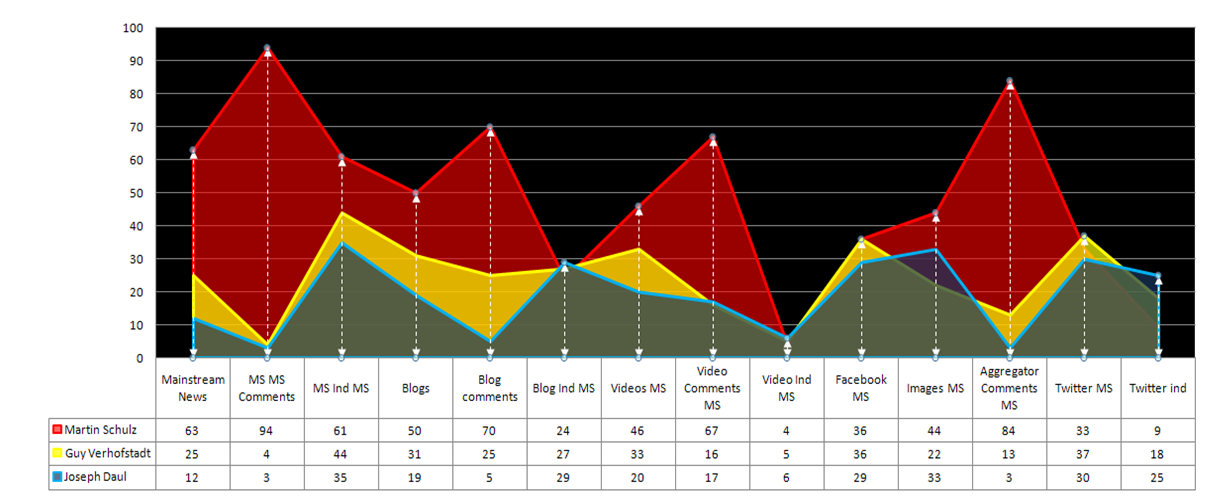
Diving back into market shares and what leader controls each medium. The chart above shows  just how dominate Martin Schulz (at the time leader of the S&D at the European Parliament. Schulz has now replaced Jerzey Buzek as it’s President) was in December. MS controlled just about every medium, as well as has the most comments.

Starting from the right we see Mainstream News percentages and how each leader stacks up:

  • Martin Schulz (MS)  63%,
  • Guy Verhofstadt (GV) 25%
  • Joseph Daul (JD) 12%

On the second box from the left “MS ind MS” shows the market share of the medium/channel, in this case mainstream, is being use by the Party Leader. Mainstream news made up 61% of Martin Schulz’s online media. Comparatively GV is at 44% and JD is 35%. In all cases main stream on-line news provides the most media and comments for all leaders. Over the past six months I’ve seen a rise in Twitter, which is by far the most equal platform, and also JD’s 2nd highest individual medium.

We can conclude two things from the prior chart:

  • MS is winning the online battle for media and engagement. He owns 94% of comments leaving only 4% to GV, and 3% to JD.
  • JD severely under performs given the EPP’s size and amount of money they have.

Active Communications

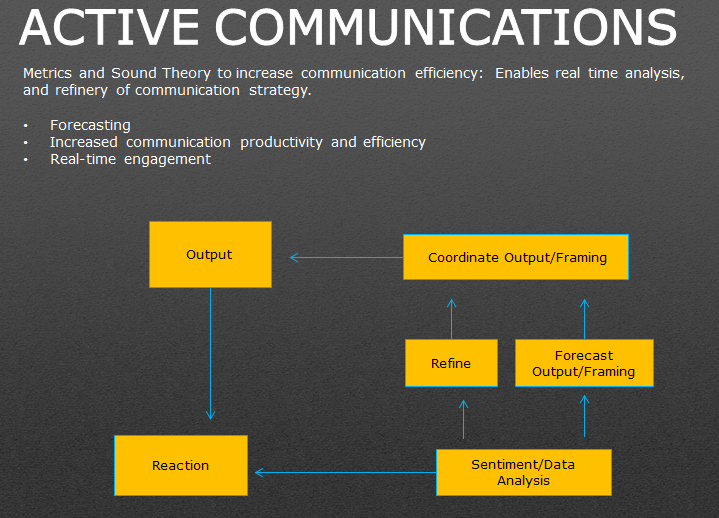
The idea of “Active Communications”  is based heavily on media monitoring listening data AND proper framing, which is a bit of an art (unless you have first class AI/NPL skills) . To work efficiently, a multi-channel infrastructure that allows for real-time content is paramount.

Important concepts to take away:

  • Timing and message coherency, to create a critical mass.
  • Trust the data for real time decision making.
  • Location based targeting with Fundamental,Technical and Sentiment analysis, per channel/medium.

Perhaps the biggest aspect is willingness to abandon prior methods after the data is received. You might be more comfortable with Twitter or another channel, but for the specific campaign it could be a  waste of time. Don’t fight up stream.

Sentiment Analysis: Why is it important?

WHY IS ONLINE MEDIA IMPORTANT TO LOOK AT?

I examine this question with the help of Charts and the EU. Thank you..Click on the Charts to make them bigger.

So why is looking at on-line media important? The chart above (Lau, 2001) shows online media has expanded in the last 16 years. Online news has displaced print and broadcast to represent 46 percent of all content monitored globally. Increasingly online communications/media is becoming the main source of people’s knowledge for political affairs. In the era of the mediatization in politics and democratic theory, which assumes that an informed and attentive public is necessary for democracy to work effectively (Lau, 2001), understanding on-line communications is vital.

The Analysis of on-line media is a cross between what’s called data science[1] and “Culturomics” (Leetaru, September 2011). The goal is to find cultural trends through computerized analysis of online media to develop insights in the functioning of human society, thoughts and actions (Michel, et al., 2011). This process has been very accurate in forecasting instances such as box office sales (Mishne and Glance, 2006) to the stock market (Bollen, et al., 2011). To illustrate the power of data science and sentiment analysis in a political context scientist – using a super computer, applied tone and geographic analysis to a 30 year worldwide news archive. The scientist were able to forecast the revolutions in Tunisia, Egypt, and Libya, the removal of Egyptian President Mubarak, the stability of Saudi Arabia, and estimated Osama Bin Laden’s hiding place within a 200–kilometer radius, in Northern Pakistan.

The point of all of this?

Media is a very accurate source for insights into the human condition, as well as our thought process. Now with the rapid expansion of online media, there is a wealth of untapped knowledge and syntax to further analyse.

EXAMPLE:
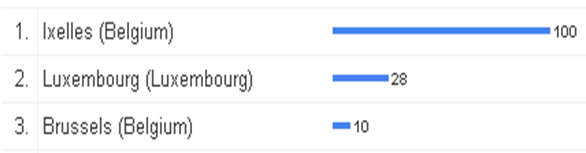
The chart above shows the volume of searches based on the terms “European Parliament”, “European Commission” and “European Union”. They were also translated into French, German and Italian for further accuracy. The data was gathered with Google Insights[1] for Search. The chart does not track positive or negative sentiment, just the volume of the terms searched through Google[2]. The data clearly shows the interest in the EU has gone down since 2004. For both the European Parliament and Commission the top locations for the searches of the term were Ixelles, Luxembourg and Brussels – all home to the institutions themselves. This illustrates the “Brussels Bubble” that so many talk about
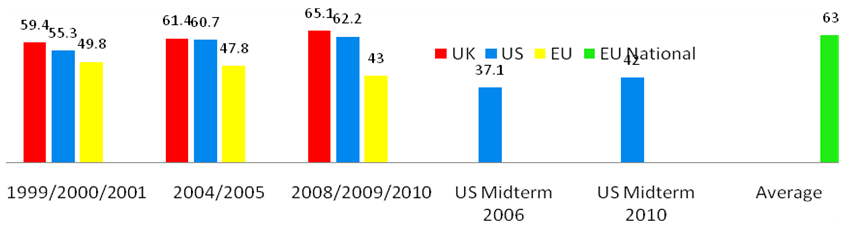
The Google insights data mirrors voting rates. In other words, voting rates (above) and participation have gone down.
The variables:
  • Lack of a unified media, hesitation on real-time engagement, failure to leverage modern instruments and an incentive to do so.
  • MEP and political parties do not have to raise money for re-election, and there is little incentive to actively engage constituents, on an individual MEP level as well since the parties puts forth the Politicians.
This frame work has lead to autonomy and citizens that look more toward national politics for answers. With the current financial “Euro” crisis it would be easy to assume that the interest in the EU – whether good or bad, would go up. This has not happened.

[1] With Google Insights for Search, you can compare search volume patterns across specific regions, categories, time frames and properties. See examples of how you can use Google Insights for Search.

[2] Google’s search market share in Europe is around 90%. In the U.S. it’s around 65%.


[1] The profession of interpreting and creating value from Data.
Communications as Productivity

By looking at Communications in terms of production and variables, you will save millions. By not understanding variables in communications, you will loose millions and time. Gone where communication firms can pass  Bullshit. Now it’s far from an art form with metrics. Clients should expect decision making based on sound research, in addition to  web analytics and online monitoring data.

The goal: Create the most productive syntax, which could be words, photos,video or interactive digital content. Not the most view and clicks

Resonance: 

Output time/date to channel dissemination, and how much time  that takes. It shows language adoption, which is how you win. There’s a saying politics, “Win the language battle, win the war”.  Resonance is a good KPI for knowing if the framing has retention, thus productivity.

Its can also be useful to reverse engineer a past event’s content and framing with machine learning to compare and contrast. Again don’t focus too much on “click and looks”. You might see exponential gain which perhaps are linked to offline events. That way you can also map correlation. I tend to see this pattern a lot working in politics. This reiterates the massive amount of information available on-line by listening.

More Tricks:

Use best practices in cognitive ICT, psychology,linguistics and behavior economics. A real expert will know captology, sentiment analysis and gamification, and not neglect fundamental and technical analysis.

When you understand the basic variables, you see that  each enhances or destroys productivity.

If the person you hired  doesn’t understand what I’m talking about, the strategy will loose productivity. Ask yourself, why we are paying 200-300 plus per hour? Educated guessing is over. The data doesn’t lie.