I decided to break down the events of John Kerry visit to Jose Barroso. The reactions are not drastic as I would have thought considering GMO’s and IP are two issues that people care about on both continents, and the Free Trade Agreement is making some actual headway. We will have more on this in the future, but here are small bits of data for starters
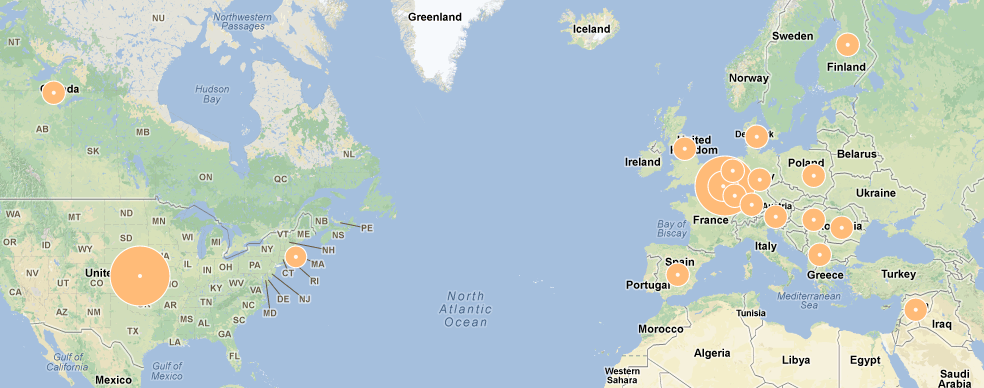
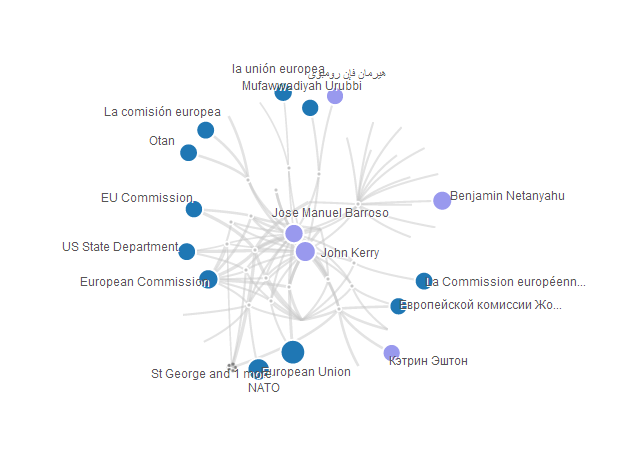
We see that the reporting on the John Kerry and Baroso event is reported on in Brussels 33 times – much more than any other area except for the entire US. Below we see events with organizations and people that both of them together are tied to.
Cross referencing what each leader said within the context above is where it gets interesting. Questions to ask: Who were their targets? Did they attain any impact?
When I first arrived to Brussels I was always amazed at how disconnected D.C was from Brussels with that I decided to look at who was following who. We see that only 1.1% follow both. In short they are disconnected networks. For Comparison sake I also did Obama V Barroso but since Obama has over 30 million follower, the tools I was using at the moment couldn’t process such large amounts of data.
Jose is trying to learn how to get a date . There’s a conference at a local hotel on how to pick up women. On his way to the room, Jose’ encounters two doors. One leads to the conference taught by men on how to pick up girls. The other door has a sign that says “Successful single women’s conference. Please join us for a drink, anyone is welcome”. Jose chooses the first door as he had planned, and continues learning about how to pick up women. The EU relationship with using technology is like Jose’s approach to trying to pick up women, hesitation and unwillingness to adapt in real-time, to the peril of the end goal – i.e. institutional.
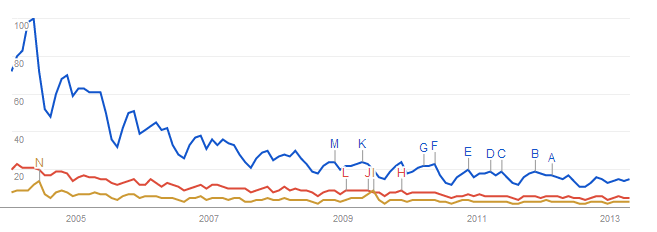
One day I was talking about online media monitoring to the institutions “social media expert”. I was asked “why do we need to understand what people are saying about us?” I was shocked and had no answer except to point out Interest in the EU has gone down every year since 2004 http://ow.ly/8w2Gs. Specifically alarming was that the Parliament, which is supposed to be the extension of the people, had the lowest interest rate.
Blue – European Union Red – European Commission Yellow – European Parliament
Now having worked in US politics, a good place to start making a more legitimate government, is being more representative of constituents..and understanding what people are saying about you allows you to create better policies and messages that can help engage people, and perhaps increase the voting rates.
Both EU firms and institutions spend way too much time discussing what technology such as social media is, or what it means, but never act. For example Friends of Europe just released a paper about social media . Frankly I found it pointless, uninteresting, and six years too late.
In the globalized future hesitation is dead, improvisation is king, and competition will be fierce…
Thinking about the “social media experts” statement further, I concluded it wasn’t that online monitoring wasn’t useful for their situation, but it’s use would have created a real-time approach. This is the antithesis of institutional process Europe is way too familiar and comfortable with. And incentive for the people working in the institutions wasn’t there either.
In the USA, competition has led to campaigns and politics becoming a science. And voting rates + political involvement have gone up.
The 2012 campaigns featured natural language processing, text mining, sentiment analysis, and data scientists. These technologies will marginalize every medium and word. There was no room for “educated guessing”. This is efficient, saves time and money, plus leaves the politicians to focus on empathizing more with the electorate. Forward to the EU. The system is not competitive. The money is provided by the public, and the European Commission is in charge of mobilizing people in a non-political way, which is inherently very, very difficult.
The future will embrace non-understanding, chaos and real-time data, you don’t get the luxury of writing a 10,000 word strategy paper. At present the EU mindset is not equipped to handle this transition. It must remember if it wants to hang out with future technology, it has to first quit talking, and ask it out on a date.
From October 25 -> December 4th there were 20,022 Tweets Containing the words European Union, European Parliament and European Commission. This means tweets were quite specific and could not be mistaken for anything else, further of course the majority of posts were in English, although more than 30 languages were represented. Many of the quick findings reinforce numerous Social Network Analysis studies which show that most network opinions and frames are controlled by a minority of people – between 10-20% i.e. elite level. Social media, despite a lot of hype, has not changed this.
The context surrounding these 20K Tweets
Were produced by 13,832 accounts
Retweets made up 28% of all Tweets
The Top 18 Tweets – in terms of most retweeted, made up 9% of all tweets
Top 18 Tweets that made up 9% of all tweets were made by 11 accounts
The most visible and retweeted Tweet was a coalition with FC Barcelona (below) – ( This leaves me to question why are there not more collaborations between the public and private sector in the EU?)
Top Accounts from Top 18 Tweets:
Wikileaks – 6 Tweets in Top 18 (33%)
Economist – 2 tweets in top 18 (11%)
Top Users commenting on the Euro. UKIP is seems to be taking a proactive approach to framing it’s primary fodder against the EU (the Euro Crisis).
Some quick thoughts about what I think is inhibiting the progress of mankind and discrediting my profession.
NLP“Neuro-linguistic programming”
For some reason this “woo” keeps coming up at communication events. Lets stop the hippie feel good stuff and get on with business. You are not a doctor. Do not give credence to feel good jargon and pass it off like science. We are all dumber for hearing these ideas. Yes, I am brain washed by my western medicine, and strict materialist atheist views.. and much better for it.
The terms Savvy/Buzz/Engagement/Guru
People should have to sit through a presentation that they are supposed to take serious and hear these painful terms. It should be assumed and implied if you are professional you will get people to interact with your content, not engage, other wise why the hell are people paying you? Further, if I ever see such words on a CV I immediately throw it away… This is used by people who have no new ideas and or are not well researched. Let the data speak for itself. Assume people are smart. You are not special because you work in media and communications.
I’ve interviewed with them all. The big firms, the small firms. Both in Brussels and in New York.
After working in the European Commission and Parliament, I wanted to go to the private side of Communications and Policy. The problem? I had been running data and insights. Using terms like NLP, Sentiment analysis, cognitive science and connotation mapping to describe what I did not work well. On the other hand dumbing down would leave me looking like another 27 year old who does “the social media” and or “the internets”. Most firms doing the interview for analytics positions wanted to hear “pivot table”, “engagement”, “influence” and maybe SPSS. Upping the hierarchy on those terms to explain why “something was” appeared unnecessary and impractical since explaining this to a clients communications director is another task with in itself.
So to hell with the PA/PR firms, I joined an IT firm that also does communications – Intrasoft International, and could not be happier. The people’s skill sets are well defined and paid, which gives them a certain confidence in contrast. They like things such as analytics and completely understand them. Their only fault is the soft side of Communications – which is now my job to merge.
IT is going to take over communications sooner than later. Current PR firms will be left scrambling. The lack of investment in the deeper meaning (abstract knowledge such as transference, retention and pragmatics) will start to show as data/connotation mining becomes a standard practice. Most IT firms already have this infrastructure in place via their AI departments.
There will be a point where dropping shit jargon is irrelevant and companies Comm Director, who should be more of a CIO/CTO in the nearer future, will see right though it.
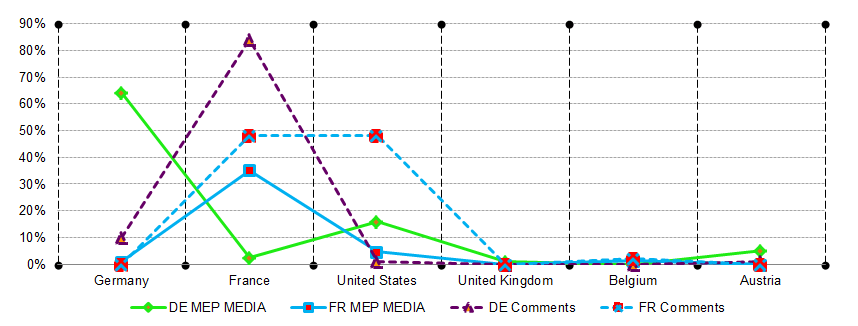
Regional online media engagement for German and French EPP MEP’s: The chart clearly illustrates Germany is not engaged with their European Parliament representation, or better, the MEPs are clearly not in touch with their constituents. Can someone say democratic deficit?
•64% of German EPP MEP media is coming from Germany.
•84% of commented media on German MEP’s is from France.
•Germany only accounts for only 10% of comments of it’s MEPs.
•Germany does not comment on French EPP MEPs (0%).
•French EPP MEP comments are from the USA and France (both 48%) and Belgium at 2%.
In the global political environment a holistic view is needed.
The standard for message delivery is high in the modern media environments. It’s vital to create communications that people identify and empathize with. The threshold to get attention, and to get people to retain your information, is even higher. Politics now competes with Pepsi, Nike and Apple. No one will take time to care about your views or propositions. Firms must be proactive in both controlling and framing language, as well as marginalizing their communication and political strategy for efficiency.
The problem: There are many variables to consider when developing productive communication and political strategies. Further, basing decisions on just educated guessing, even for the most highly skilled and experienced professional, does not meet the standards of modern business practices, which use analytics to make decisions.
The Solution: Online media provides an immense amount of information which can be monitored. The data can be used to track political and policy instances qualitatively, as well as forecast.
To do this, we must synthesize research in cognitive linguistics and Natural Language Processing (NLP). In the last few years these technologies have evolved to the point where pragmatics can be quantified accurately. And further, because of the amount of data an average person creates in a day, we have and endless amount of information to drill down into for examining political and cultural phenomenon.
I’m currently looking at the French elections. There will be more on that and this in a bit.
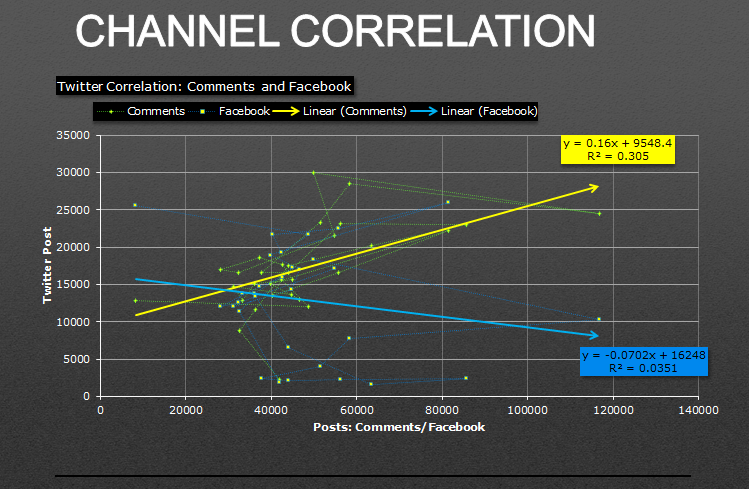
The Chart shows the correlation of Media comments and Facebook posts, in reaction to Twitter output , in regards to GOP primary Candidates. It’s no surprise there is a downward trend for Facebook. The two channels tend to be segregated politically. Twitter being more conservative and Facebook being more liberal.
I’m very surprised Santorum, though unelectable to the general population, is still in the race still. Although the more Romney talks, the harder it is to watch. It’s almost like he hires too many “Yes Men”. He needs a campaign manager that will slap him when he goes on a rant about trees in Michigan. Who says that kind of stuff? I predict this now; Obama wins..





 Machine Lens