Looking at strategy & markets through data science and machine intelligence.
Author: Chandler T Wilson
Do to fundamental market shifts; organizations now find themselves operating within increased volatility, uncertainty, complexity, and ambiguity (VUCA). As a result, there are fewer markets with unknown opportunities and places to hide during market turbulence.
Business, both big and small, will need to shift their thinking on what work, strategy, and creativity are. The majority of processes deployed at organizations are superficial and lead to a marginal compared, if any, competitive advantage, or built on assumptions that are no longer relevant or accurate.
At Walmart, I work on machine intelligence to optimize corporate strategy and business processes for the VUCA age. By analyzing market trends and strategic frameworks with machine intelligence and algorithms, I've come to the conclusion that competitive advantage lay in the embrace of complexity, faster information to action times, and the unorthodox, as well as being agnostic to how an entity makes money or reacts to markets - especially for asset-rich businesses. This site is meant to house some of my research and thinking in the above areas. The views and comments expressed here are my own and do not represent companies I have worked for or with.
In the next 25 years I question how the EU will avoid marginalization between Asia and the US? The US is more dynamic and entrepreneurial. From Apple, Google, Microsoft, Facebook to Pinterest, the list goes on. There’s low investment cost for incorporation, 600% more skilled immigration, congruent legal and professional standards across all states, and 20% more productivity per worker/year. Asia has cheaper manufacturing, growing disposable income and a favourable investment climate. Both have higher patent rates and less labour/tax issues. Given the advances in technology and the higher gains conceivable by those who adopt faster, these facts can quickly become more pronounced.
So how will EU leadership plan to address these issues during political instability, and lack of leadership in the first place? Europeans need to realize the debate needs to be beyond national pride at this point.
Frames: The use of mental filters to make sense of incoming messages. All views are Framed and are constructed through schemas that influenced how we interpret the message. The goal of a communication professional is to create rhetoric that consciously or unconsciously acts to construct a point of view, and make language more inclusive to constituents.
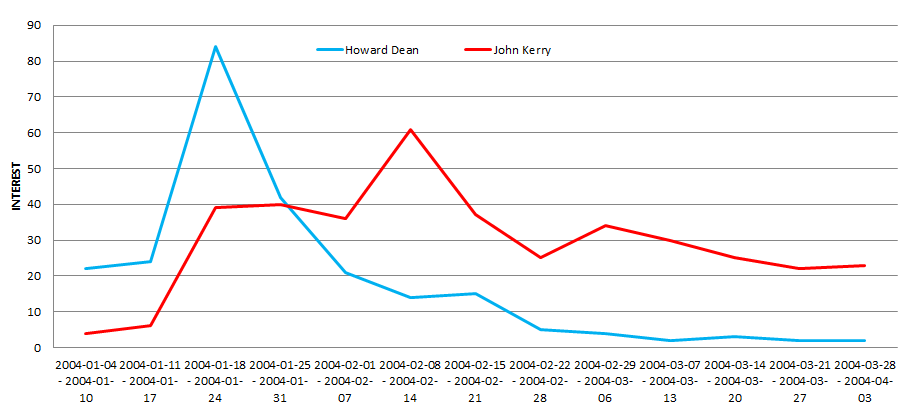
The graph show search interest of Howard Dean and John Kerry in 2004. You can see the Dean Scream had a drastic effect.
“The ability to connect via the Internet to groups, segments, and individuals changes everything. It flattens the process and creates a bottom-up approach to participation,”
– Joe Trippi, Pioneered the use of the Internet in Howard Dean’s 2004 (Greengard, 2009).
The internet has been used for politics since the mid-1990s. The Web 1.0 sites were basically e-brochures where candidates would post updates, news, information and their position on issues. While the sites helped people get information and candidates voice their views, they did not target voters. During the 2004 Presidential Democratic Party preliminaries, Howard Dean started targeting potential voters.
Dean’s campaign was the first to solicit on-line donations, in a successful manner, and raised the most money of all DFL candidate ($25.4 million), second only to George Bush ($84.6 million) (JUSTICE, 2003).
Dean used the internet to form coalitions, meet up groups and targeted fundraising ads. The last point is of interest because it changed the SOP for fundraising. Past campaigns relied on “Big Money” donors. For candidate from lesser populated areas, the “Big Money” structure was inefficient. Overhead from travel, facilities and the fact there are not that many big money donors out there, were big road blocks. Obviously, this process led to a level of exclusion and elitism by not incorporating “average folk”.
Dean was able to solicit large amounts of money, with targeted ads, from many small donors. This led to a level of inclusion which bought political points with television, and made a candidate from Vermont the front runner out of nowhere. Further it was the first time a Democrat chose not to receive federal matching funds program (sourcewatch, 2008).
While Dean’s campaign was the first to harness the web,he was the first one to die politically from it as well. On January 19, 2004, just as Dean’s campaign gained momentum, on a cold day in Iowa, the “Dean Scream” or “I Have A Scream speech” was born. What many people do not know is Dean was very sick. The microphone mostly picked up Dean, not the audience. During the rally, the “Dean Scream” would have been unnoticeable to most.
This caption, replayed many times, sealed the coffin for the campaign. The action looked unpresidential according to political pundits (Gayember, 2004). The new era of political communication had just begun. It wasn’t a policy, lack of funds or support that ruined Dean, it was one action, then finished. 24/7 communication had made the political world a place where one bad action could ruin a campaign. Instead of flattening the playing ground, the standard has become so high that Joe Trippi’s statement above, is now, just a dream.
On another note, here are some facts about the 2008 elections. How will they change for 2012?
During the 2008 election there was a shift in election campaign output. (Cisco Systems, 2008 )
Television 82%
Internet 62%
Newspaper/magazine 49%
Radio 30%
On-line video 30%
Cell phone/mobile device 4%.
75 percent of these on-line video users felt that watching video on-line enabled them to follow presidential election news and events more closely.
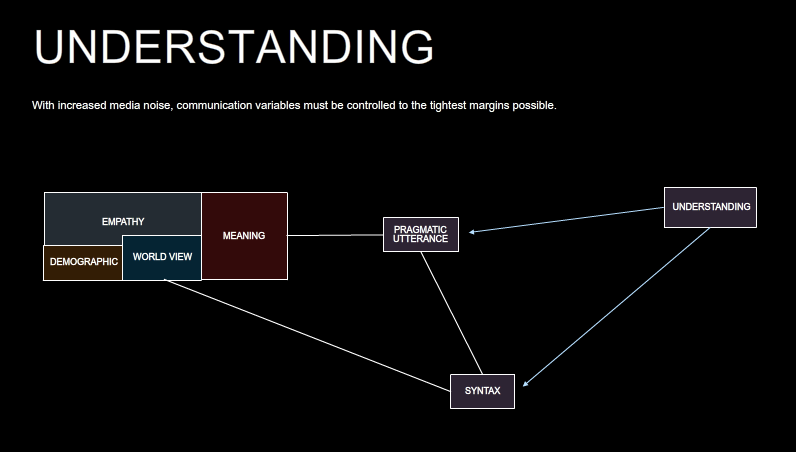
I’m interested in the pragmatics. The utterance on the medium, not the mediums themselves. And then the understanding of the utterance, from a cognitive perspective.
Why?
This is the key. Media, rhetoric and influence doesn’t go beyond pragmatics. Until the days when we hook our selves up to a computer, and that day will come, we have to rely on understanding the interaction between syntax and utterance, with in a multi-variable context. Variables could include Channel – Facebook, LinkedIn, New Papers, Tablets,PC, Mobile. Each has a specific type of interaction and legitimacy structure. Once adopted, a Frame is pushed and the culture crated. By looking at the interaction between Man and machine, we get valuable information. This is researched with in the study of Captology from the Stanford lab. It’s headed by B.J. Fogg. Very interesting stuff.
More a bit later. I need a cafe, you can loose yourself in the logic surrounding this type of thinking.
While it’s trendy for public affairs professionals talk about social media, Twitter and Blogs, it’s naïve to think these are the main channels for engagement when it come to European Parliament Party leadership. Online mainstream news simply dominates in comparison. It sets the tone of the issue, gets the most comments, and is shared ,“Liked” and Voted on the most.
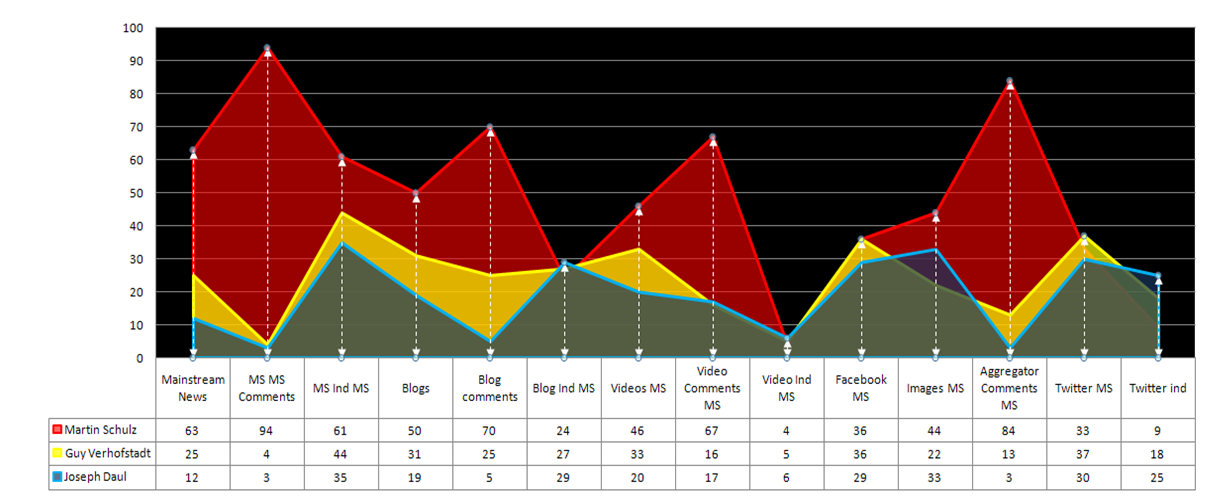
Diving back into market shares and what leader controls each medium. The chart above shows just how dominate Martin Schulz (at the time leader of the S&D at the European Parliament. Schulz has now replaced Jerzey Buzek as it’s President) was in December. MS controlled just about every medium, as well as has the most comments.
Starting from the right we see Mainstream News percentages and how each leader stacks up:
Martin Schulz (MS) 63%,
Guy Verhofstadt (GV) 25%
Joseph Daul (JD) 12%
On the second box from the left “MS ind MS” shows the market share of the medium/channel, in this case mainstream, is being use by the Party Leader. Mainstream news made up 61% of Martin Schulz’s online media. Comparatively GV is at 44% and JD is 35%. In all cases main stream on-line news provides the most media and comments for all leaders. Over the past six months I’ve seen a rise in Twitter, which is by far the most equal platform, and also JD’s 2nd highest individual medium.
We can conclude two things from the prior chart:
MS is winning the online battle for media and engagement. He owns 94% of comments leaving only 4% to GV, and 3% to JD.
JD severely under performs given the EPP’s size and amount of money they have.
Unfortunately the high cost of doing business – taxes, labour laws and questionable professional standards across all member states, threatens to marginalizes the EU between Asia and the US.
USA= Innovation, quick to adapt, dynamic work force, large integrated market.
Asia = Cheap labour, willingness to adapt, on the up and up.
The main issue is hesitation to adopt any new methods. In a knowledge economy such as the EU, liquidity of knowledge is a huge asset. None the less, as we see from the data debate, there are only worries and fears, no positives. This is partly Google and Facebook’s fault for not controlling the debate better, although with the cultural differences, I’m not sure it matters.
What ever side of the debate you are on, there is no way the Commission/Parliament will be able to regulate at the speed that such companies innovate and develop new technologies.
I liken it to a scenario:
Jose is trying to learn how to get a date. He decided to go to a conference at a hotel that explains how to do this. On his way to the room where the conference was being held, Jose encounters two doors. One leads to the conference on how to pick up a date. The other door has a sign that says “Successful single women’s conference. Please join us for a drink. Anyone is welcome”. Jose chooses the first door as he had planned, and continued learning and taking notes about how to get a date. The EU relationship with Technology is a lot like Jose’s approach to picking up a date, hesitant and unwilling to adapt in real-time, to the peril of the end goal.
In October I was giving a presentation about on-line media, trend, and sentiment analysis/monitoring to institution officials. During the presentation I was asked “why do we need to understand what people are saying about us?” Admittedly I was a bit shocked. Interest in the EU has gone down every year since 2004 http://ow.ly/8w2Gs, as well as voting rates. In my view a good place to start building a proper message that mobilizes people, is to find out how people perceive and talk about you in the first place. Thinking about the institution officials statement further, I concluded the real issue wasn’t that that online monitoring couldn’t be useful for their goals, but it would have created a real-time approach, the antithesis of the institutional process Europe is familiar with. The incentive wasn’t there either.
In the globalized future hesitation is dead, improvisation is king, and competition will be fierce. Both EU firms and institutions spend too much time discussing what technologies such as social media mean or can do but never act. On the opposite, competition is the USA led to elections becoming a science. The 2012 campaigns will feature natural language processing, text mining, sentiment analysis, and data scientists. These technologies will marginalize every medium and word. There will be no room for “educated guessing”. This is efficient and saves time and money. Further it may help yield larger voter turnout as did the 2008 U.S. elections. Forward to the EU. The system is not competitive. The money is provided by the public, and the European Commission is in charge of getting people to vote with a neutral message. And they are still having conferences about what social media means.The future will embrace adaptability and change, you don’t get the luxury of writing a 10,000 word strategy paper, or a controlled institutional process, life and business move too fast. If the EU is going to have a chance using technology to it’s full advantage , it must first take a shot, and ask it out on a date.
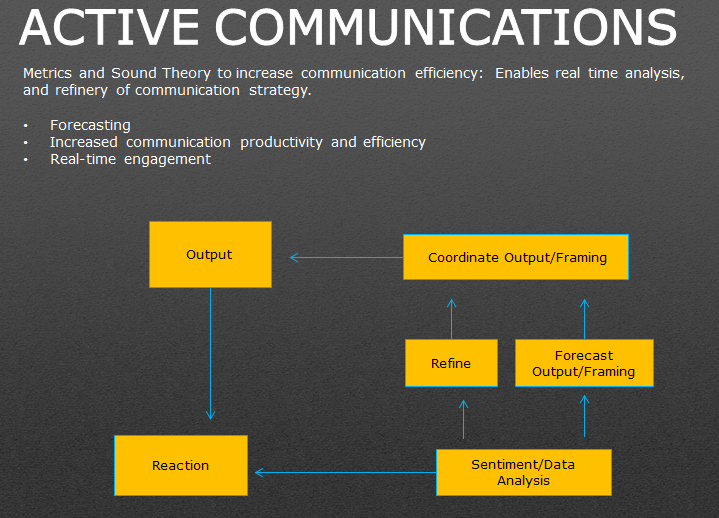
The idea of “Active Communications” is based heavily on media monitoring listening data AND proper framing, which is a bit of an art (unless you have first class AI/NPL skills) . To work efficiently, a multi-channel infrastructure that allows for real-time content is paramount.
Important concepts to take away:
Timing and message coherency, to create a critical mass.
Trust the data for real time decision making.
Location based targeting with Fundamental,Technical and Sentiment analysis, per channel/medium.
Perhaps the biggest aspect is willingness to abandon prior methods after the data is received. You might be more comfortable with Twitter or another channel, but for the specific campaign it could be a waste of time. Don’t fight up stream.
Positive (P) and negative (N) sentiment are just transmitting two results based on many other variables. This in itself contains little knowledge. For creating strategy, it can only bench mark after the fact.
Inherently the use of data is to make better decisions for the future. Production is expensive and time consuming. So is deductive reasoning. The main goals should be to move away from adjusting to the end reaction and migrate to a predictive model. Look at the context in higher resolution i.e. control for variables which lead to PN sentiment.
Here are some suggestions
Time of day
Medium (Twitter,Facebook ,Blogs, Mainstream news)
Comments PN sentiment
New dissemination to comment count (time, PN)
If you are advanced, use NLP tools that allow for custom taxonomies – within the NLP, to create rules on varibels like types of framing. On a medium level this is very good at prediction, but more on that later.
I examine this question with the help of Charts and the EU. Thank you..Click on the Charts to make them bigger.
So why is looking at on-line media important? The chart above (Lau, 2001) shows online media has expanded in the last 16 years. Online news has displaced print and broadcast to represent 46 percent of all content monitored globally. Increasingly online communications/media is becoming the main source of people’s knowledge for political affairs. In the era of the mediatization in politics and democratic theory, which assumes that an informed and attentive public is necessary for democracy to work effectively (Lau, 2001), understanding on-line communications is vital.
TheAnalysis of on-line media is a cross between what’s called data science[1] and “Culturomics” (Leetaru, September 2011). The goal is to find cultural trends through computerized analysis of online media to develop insights in the functioning of human society, thoughts and actions (Michel, et al., 2011). This process has been very accurate in forecasting instances such as box office sales (Mishne and Glance, 2006) to the stock market (Bollen, et al., 2011). To illustrate the power of data science and sentiment analysis in a political context scientist – using a super computer, applied tone and geographic analysis to a 30 year worldwide news archive. The scientist were able to forecast the revolutions in Tunisia, Egypt, and Libya, the removal of Egyptian President Mubarak, the stability of Saudi Arabia, and estimated Osama Bin Laden’s hiding place within a 200–kilometer radius, in Northern Pakistan.
The point of all of this?
Media is a very accurate source for insights into the human condition, as well as our thought process. Now with the rapid expansion of online media, there is a wealth of untapped knowledge and syntax to further analyse.
EXAMPLE:
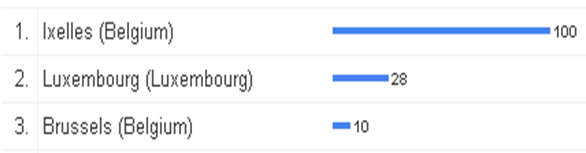
The chart above shows the volume of searches based on the terms “European Parliament”, “European Commission” and “European Union”. They were also translated into French, German and Italian for further accuracy. The data was gathered with Google Insights[1] for Search. The chart does not track positive or negative sentiment, just the volume of the terms searched through Google[2]. The data clearly shows the interest in the EU has gone down since 2004. For both the European Parliament and Commission the top locations for the searches of the term were Ixelles, Luxembourg and Brussels – all home to the institutions themselves. This illustrates the “Brussels Bubble” that so many talk about
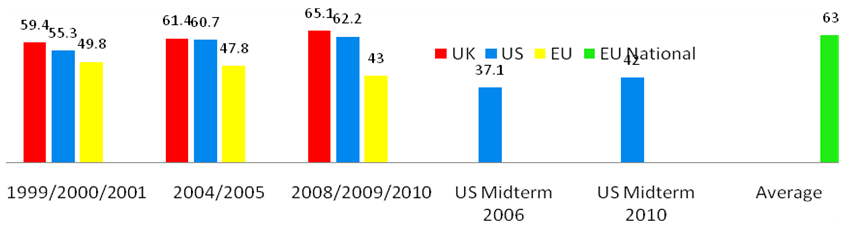
The Google insights data mirrors voting rates. In other words, voting rates (above) and participation have gone down.
The variables:
Lack of a unified media, hesitation on real-time engagement, failure to leverage modern instruments and an incentive to do so.
MEP and political parties do not have to raise money for re-election, and there is little incentive to actively engage constituents, on an individual MEP level as well since the parties puts forth the Politicians.
This frame work has lead to autonomy and citizens that look more toward national politics for answers. With the current financial “Euro” crisis it would be easy to assume that the interest in the EU – whether good or bad, would go up. This has not happened.
[1] With Google Insights for Search, you can compare search volume patterns across specific regions, categories, time frames and properties. See examples of how you can use Google Insights for Search.
[2] Google’s search market share in Europe is around 90%. In the U.S. it’s around 65%.
[1] The profession of interpreting and creating value from Data.


 Machine Lens
