Blurring of Online and Offline

A few months ago on Twitter I saw “@martensepp not allowed to visit @tymoshenko” and I took it for granted.

After I realized  – and while it may seem simple, the fact that my brain did not have to process what this meant was of interest to me.

After a  couple of check downs I figured this meant there are no more social media experts now than there were during Thomas Jefferson’s era. The syntax keep changing but the meaning is the same. TJ would be just as good today.

Online and Offline = Blurring.  Maybe more on this later.. Maybe not. Just a thought.

Communications from a productivity perspective = not happening in Brussels..The data doesn’t lie.

For some reason in Brussels it’s not about productivity and developing margins for communication strategies. According to Mckinsey, a data based approach on average out performs educated guessing by  6-7%. All I ever see business do is promote logistics in operations while neglecting a process based, quantifiable approach to internal and external communications. On a Corporate or Institution level this is millions of Euro wasted.

In Brxl educated guessing is the preferred way to develop a communications strategy and we wonder why voting rates/interests go down every year .. Still blank stares as to “why?”..To communications people and firms!! It’s not about policy or white papers.  It’s about empathy and simplicity..Aren’t we supposed to be the progressive/creative branch? I think we can do better, and either we do or we will have to eat the BS. The industry in Brxl can’t hide much longer. The data doesn’t lie.

The good news is  I know for certain it can be developed.. There is some interest.

Peace CTW

Framing

In politics controlling language is vital. George Lakeoff (Linguist -Cal Berkley) confirms brain will generate a physical cognitive bias if you win the language war. Because of the frame being repeated, the attitude towards the subject changes.

For example the party who introduced the term wins solely on sheer mass. This can be determined by the total count of the terms.

For example: ”Death Tax” or “Estate Tax”. We also know the terms that we introduced to the discussion. Hence the campaign works when the Language has been adopted. It might not seem like much but these are long term goals and or policy matters to keep or change a status quo.

Response to Conversation Impact

CI can be found here 

In looking at Conversation Impact I think – it’s simple and clear which is important for creating a KPI. More importantly CI can be applied

easily across numerous campaigns. I think the main thing that I would add to CI model is accounting for the message framing and looking at mediums as separate instruments. Much of my political work involves this since it can shape perception and offer insight to what type of conversation is going to have the best ROI per medium and influencer. Each tends to have a different pattern that can make it possible to measure CI more accurately. In short there’s a lot of information in each medium interaction and this needs to be clearly separated.

For Figure 1:

The survey instrument – do  surveys correlate to an accurate representation of sales and behavioural change? I’m always sceptical of asking for an opinion i.e. “would you now do x?” or “purchase intent”.

To gain insight I’ll look at online and offline (attending a conference or event) actions. The more complex the task the constituent is willing to go through the more important I’ll view the issue/policy (in a political context). Also If someone posts a comment – I value this more than a “like” or “Vote” or mentions put forth by media as it shows more effort. The question for us all is if this translates into a vote or purchase.

I tend not to rely on automated sentiment as much – in political post (generally negative) it makes it very hard. To counter this specifically in Radian 6 I’ll Boolean for negative terms. As long as it is consistent across everything (like in CI) it can none the less be a good measuring stick and I have done this before.

Figure 2

The graph which illustrates Influencers led to a 6.3:1 rise in network influence. The study that I read was about a 5:1 ratio – so in your case it was a bit higher. Was this sustainable past March 09? Also was the campaign coordinated on traditional mediums and perhaps cross referenced with something like Cision Point which accounts for traditional news? The data from this would be interesting. On and offline merging is what I tend to measure/compare the most.

Also in my work I tend to see exponential gains in sentiment/mentioned but it’s usually built off an off-line instance like a political speech/conference or elections (shown in my Political Intelligence presentation pg 20).
If they were measured what was the sentiment/mentions before after a main event (if there was) for “X” to happen – like a conference, election or product releases? What was the ratio in the gains?

I think the figuring out the market shares or volume is right on. I’ve looked at this extensively with political party mentions by share of seats in parliament across all mediums to measure under/over performance.

Some Thoughts:
I’ve always wanted to “gamify” a campaign to measure what options people choose with in a situation. As we funnel down the process/engagement from a click of an online advertisement, to downloads, to checking in to a place via foursquare etc. and or using an off/on line app like Layar; This could provide a good way to measure campaigns to see what way behaviour can be modified from the digital realm and how best to do it. This is why I love the study of Captology.

Ultimately while it’s easy to make things more accurate, but it also gets complex and becomes hard measure for a multitude of brands/products. I think Conversation impact does a good job of measuring specifically what it’s supposed to – conversation. My only suggestion would be to find a way to account for framing techniques on a per medium basis and what technique generates the most engagement (comments, likes, votes). If we as influence marketers can crack the cognitive and linguistic code would be the Holy Grail and I think looking at data is the first step.

Please feel free to ask any questions.
IS SOCIAL MEDIA CHANGING EVERYTHING?

Well yes and no. [Good] PR has always been about understanding human perception/biases not “emotional IQ” or “social media savvy” [bad PR]. The medium in this case – “Social” Media, is just another way to leverage and understand innate human traits/bias. Although there is some evidence that illustrate some biases are dynamic/changeable, largely people are not interacting much different now from the digital realm than real life. i.e. human behavior and cultural patterns/perceptions and need for expression creates the digital or social media instance – not the other way around. In other words Bernays would be just as effective now as he was then. The medium to the method is mostly arbitrary to said human behavior/bias needed to be leveraged.

Active Democracy: Using Social Media and Online Data to Better Serve Constituents

The Focus groups and Polling maybe dead. Maybe even voting is next? After all what is the point? Collectively our voice can now be quantified and heard with the help of sentiment and analytic analysis. Good goverments are utilizing this to find what constituents and civil society wants.  Added to  direct advocacy via social media and online forums, the possibility for organic mobilization is apparent and in front of our face.

Currently I work on political strategy for the EPP Group at the European Parliament. What I am implementing makes it so no matter what you say online – we are listening to you. In essence this is active democracy. If you talk about GMOs or Data protection I hear it, quantify it and then we get a political strategy to address it. A feedback loop of sorts.

On the EU level this is important because of the autonomy with constituents the EU has. The EPP Group is trying to address this with technology in the most efficient and effective manner available today.

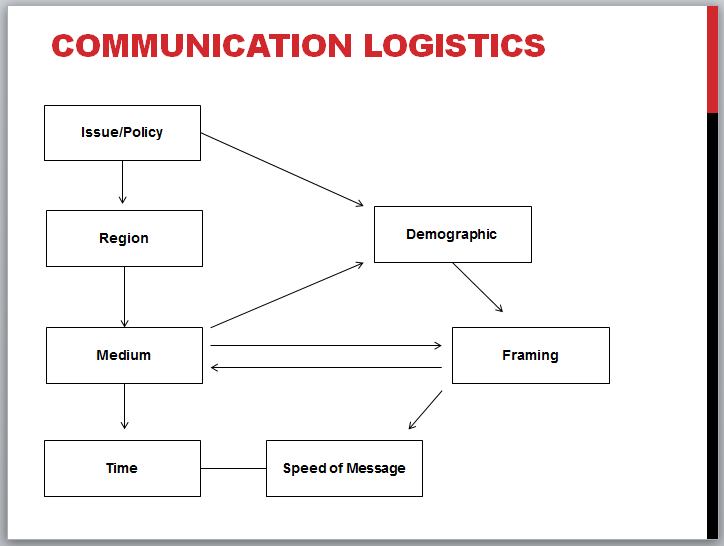
Time to go see a live show at Mr.Wongs in down town Brussels (Bours). Check out the picture of what I dub “Communication Logistics”.

– CT

European Parliament Leadership sentiment: Guy Verhofstadt Wins

The chart illustrates that overall sentiment of Group Leadership in the EP.

Joseph Daul who is president of the EPP Group (largest EP Party) is lower than Guy Verhofstadt (ALDE) and Martin Schulz (S&D). During the state of the Union address (first spike) Schulz  beat out Verhofstadt. This had to do with the S&D being perceived as competitor to Jose Barroso so the general media sought out his for his views on the event/speech.
Blue = Joseph Daul
Yellow = Guy Verhofstadt
Red = Martin Schulz
Online Web Sentiment of European Parliament Leadership

EU Headline Trends the last 30 days

The Graph (click to make larger) illustrates what has been trending in the EU the last 30 days – as far as headlines are concerned. Political Actors should be on these trends  if they want to raise their profile by association. You are welcome for the free advice. Ciao!

Using Analytics and Online Media Monitoring in Public Affairs

For mission critical applications as well as routine tasks online monitoring can help bolster efficiency for any  NGO, Political organization or institution’s communication strategy.

Why? In politics empathy is king.

Without empathy it’s impossible to foster a community and identity to get buy in. This applies to every political agenda/view you are trying to push. One of the first mistake people make in public affairs is thinking that everyone should agree with there view because “the  fact” are on your side.  The  reality is people could care less about  statistics and just want to how how an issue effects them.


Political Mediums:EU

Mainstream media is still the place where the majority of “open debate” is taking place. While blogs account for 74% of all EU media, most of it is polarized and full of Group Think. These factors provide slim chance to change people’s opinion on a subject matter. Further network studies are showing that 20% of “Multipliers” pull the other 80% along. While there have never been more mediums for folks to share their thoughts on, legitimacy is still at a premium and the definition of such is constantly changing.